You Don’t Need More Techniques. You Need a Game.

One of the strange things about getting better at Jiu Jitsu is realizing just how many techniques you know and how few of them you actually use.

After years of training, I’ve learned dozens of submissions, sweeps, escapes, takedowns, guard passes, and combinations. I’ve drilled techniques that I thought were amazing when I first saw them. I’ve watched instructionals. I’ve saved videos on Instagram and YouTube that I was absolutely convinced I would try at the next class.

And then the roll starts.

Suddenly, I can’t remember half of it.

Sometimes I’ll finish a round and realize I had several opportunities to attack but didn’t recognize them until afterward. Or I’ll get into a position where I know I have options, but instead of flowing into one of them, my brain seems to start flipping through an imaginary Jiu Jitsu encyclopedia.

What am I supposed to do from here again?

The problem isn’t necessarily that I need to learn more Jiu Jitsu.

Maybe I need to get better at using the Jiu Jitsu I already know.

Maybe what I really need is a game.

Collecting Techniques

When we’re new to Jiu Jitsu, collecting techniques feels like progress.

You learn an armbar.

Then a triangle.

Then a kimura.

Then somebody shows you a cool back take.

Next week your coach teaches another variation.

Before long, you’ve accumulated a huge collection of moves.

The problem is that having a collection of techniques isn’t the same thing as having a system.

It’s like owning a garage full of tools but having no idea which one to grab when something breaks.

A Jiu Jitsu game gives those tools organization.

Instead of asking, What techniques do I know from here?, you begin asking something much simpler:

Where am I trying to go?

That’s a very different question.

Your Game Gives You Direction

I’m starting to think a good Jiu Jitsu game should work almost like a map.

If I’m standing, where am I trying to take the match?

If I end up on bottom, which guard am I trying to establish?

From that guard, what is my highest percentage sweep or submission?

If my opponent shuts that down, where does their defense take me?

If I get on top, what position am I trying to reach?

And once I get there, how do I finish?

That’s a game.

It doesn’t mean you only know five techniques. It means you have a handful of techniques that you understand deeply enough to connect together.

Your opponent closes one door and, ideally, their reaction opens another.

That’s when Jiu Jitsu starts becoming less about remembering moves and more about recognizing patterns.

The Submission Problem

I’ve noticed this particularly with submissions.

There are times when I’m rolling and feel like I’ve forgotten every submission I’ve ever learned over my seven years of training.

I’m controlling. I’m moving. I’m surviving. I may even be getting into dominant positions.

But where are my attacks?

Then afterward I can think of five things I could have attempted.

I don’t think the answer is learning five more submissions.

If anything, that’s probably making the problem worse.

The better question is: Which submissions do I want to become known for?

Maybe I don’t need twenty different attacks from side control.

Maybe I need two that work together extremely well.

If my opponent defends the first, their defense creates the second.

And if they shut down both, maybe that reaction gives me the opportunity to advance position.

Now I’m no longer searching my memory for a move.

I’m following a path I’ve traveled hundreds of times.

Your A-Game Isn’t Cheating

There’s sometimes an assumption that being a good grappler means being good everywhere.

Eventually, sure, we should try to become well-rounded.

But watch experienced grapplers and you’ll notice something: they have preferences.

They have positions they want.

They have guards they trust.

They have passes they repeatedly find.

They have submissions everyone in the academy knows they’re looking for and somehow they still catch people with them.

That’s not a lack of creativity.

That’s expertise.

There’s something powerful about having an opponent know exactly what you want and still being able to take them there.

Your A-game becomes the foundation everything else grows around.

Depth Before Width

Maybe part of getting better at Jiu Jitsu is eventually changing the question.

Instead of:

What else can I learn?

We start asking:

How much better can I become at what I already know?

Can I hit that sweep against someone who knows it’s coming?

Can I get to my favorite position against a better grappler?

Can I recognize the transition before I have to consciously think about it?

Can I connect my best takedown to my best pass, my best position, and eventually my best submission?

That’s depth.

And depth takes time because you’re no longer simply learning what a technique looks like.

You’re learning timing.

Reactions.

Counters.

Counters to counters.

You’re learning when the technique isn’t there.

That’s the difference between knowing a move and owning it.

Build Something That’s Yours

I still want to learn new techniques. That’s part of what keeps Jiu Jitsu interesting.

But I’m becoming less interested in collecting moves just for the sake of collecting them.

Some moves just aren’t for me. They may not feel right for various reasons.

I want connections.

I want to know where I’m going.

I want certain positions to feel like home.

And I want to develop a game that reflects who I am as a grappler… my body, my age, my strengths, my limitations, and the way I naturally move.

Maybe that’s one of the transitions that happens as you progress in Jiu Jitsu.

At first, you’re trying to learn everything.

Eventually, you start figuring out what’s yours.

So the next time you feel like you don’t know enough techniques, maybe the answer isn’t another instructional or another move saved to your phone.

Take inventory of what you already have.

Pick your best positions.

Pick your highest-percentage attacks.

Figure out how they connect.

Then drill those paths until you don’t have to search for them anymore.

Because at some point, you probably don’t need more Jiu Jitsu.

You need to turn the Jiu Jitsu you already know into your Jiu Jitsu.

When Everyone Else Gets Promoted

Promotion nights are supposed to feel good.

People clap. Teammates smile and congratulate each other. Coaches tie new belts around waists that have spent months or years earning them. There are pictures, hugs, handshakes, and plenty of jokes about being a sandbagger or quitting now that someone has gotten their blue belt.

But promotion nights can also bring out another emotion that people do not always want to admit.

Disappointment.

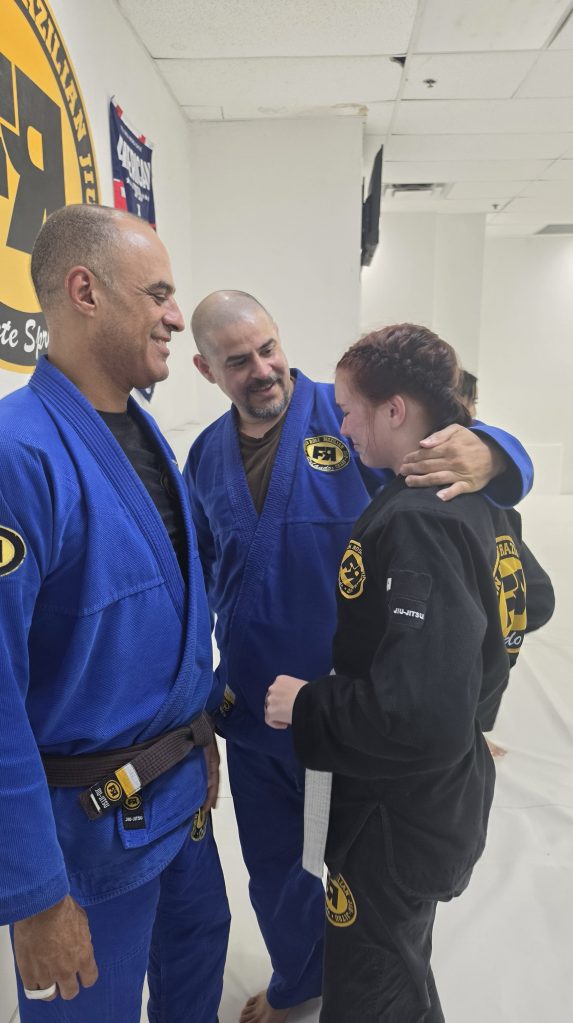
I noticed it recently when several people at our academy were promoted. Most of the room was celebrating, but one of our white belts looked discouraged that his name had not been called.

I understood it. He watched as other white belts he trained with got promoted to blue and it made him question, “Why not me”. Heck, that same night one of my favorite teammates got promoted to brown belt and I didn’t, but it didn’t bother me because as a purple belt, I’m in no rush. I know I have things I need to work on and enjoy the process of being a purple belt. But also, I know it’s different for white belts. It’s different because white is the beginner belt and if you’ve been training for over twelve months or so, you may start to feel like you’re no longer a beginner and deserving of the next level.

Even when we are genuinely happy for our teammates, it can still hurt to watch someone else receive something we have been hoping for. We clap for them, shake their hand, and tell them congratulations, while a quieter voice inside us asks:

What about me?

Comparison Comes Naturally

Jiu Jitsu is full of comparison.

We compare how long we have been training. We compare how often we attend class. We compare who taps whom, who competes, who learns faster, and who seems to get more attention from the coaches.

Promotions make those comparisons harder to ignore because the difference becomes visible.

Yesterday, you and your teammate were both white belts.

Today, one of you is wearing blue.

It is easy to look at that moment and turn someone else’s promotion into a judgment about your own progress.

Maybe the person who got promoted started after you.

Maybe you believe you give them difficult rounds.

Maybe you attend just as often.

In case of this white belt in particular, I know a big part of it is his attitude when it comes to losing rounds and matches. Jiu Jitsu is a humbling sport and it can make you a very humble person.

Maybe you have already convinced yourself that you were ready.

That is when disappointment can quickly become resentment.

Instead of thinking, They earned that, we begin thinking, Why them and not me?

That reaction is human, but it is also something we have to be careful with.

Someone else’s promotion is not proof that you are failing.

Their progress does not erase yours.

You Never Know the Whole Story

One of the problems with comparison is that we usually compare what we can see while ignoring everything we cannot.

You may see someone receive a belt, but you may not see the extra classes they attend, the questions they ask after training, or the improvements the coach has noticed over time.

You may not know how consistently they have trained, how they respond to coaching, how they treat newer students, or how much their understanding of Jiu Jitsu has grown.

You also may not fully understand what your own coach expects from you.

Different students need different things.

A younger athlete may be judged partly on pace, competition performance, and physical execution. An older hobbyist may be measured more heavily on technical understanding, consistency, composure, and safe training.

One person may need to become more aggressive/assertive.

Another may need to calm down.

One student may need better offense.

Another may need to stop relying on strength.

That is why two people can train for a similar amount of time and still be on different promotion timelines.

The belt is the same.

The path to it is not.

The Belt Can Become Too Important

There is nothing wrong with wanting to be promoted.

Belts matter.

They represent achievement, recognition, and years of work. Anyone who says belts mean absolutely nothing is probably oversimplifying things.

But problems begin when the belt becomes the only evidence we accept that we are improving.

A student may be escaping positions that used to trap him.

He may be breathing more calmly under pressure.

He may be learning how to protect himself, control his energy, and recognize submissions before it is too late.

He may be becoming a better teammate.

But if his belt remains white, he may convince himself that none of that growth counts.

That is the trap.

Jiu Jitsu gives us many promotions before anyone changes the color around our waist.

The first time you survive a round without panicking is a promotion.

The first time you successfully use a technique you have been drilling is a promotion.

The first time a brand-new student asks you for help is a promotion.

The first time you lose a round without making excuses is a promotion.

Nobody gathers the academy together to recognize those moments, but they matter.

They are signs that you are becoming a better grappler, even when there is no ceremony.

What Do You Do With the Disappointment?

Telling someone not to feel disappointed usually does not help.

You cannot always control the first emotion that shows up.

You can, however, decide what you do next which is more important.

You can become bitter, withdraw from your teammates, and convince yourself that the coach does not see you.

Or you can use the disappointment as information.

Ask yourself honest questions.

Am I training consistently?

Am I listening to coaching?

Am I trying to learn, or am I only trying to win rounds?

Do I rely too much on strength, speed, or one favorite position?

Am I helping create a healthy training environment?

You can also respectfully ask your coach what areas you should focus on. Not to argue your case or demand an explanation, but to gain direction.

A good question is not, “Why didn’t I get promoted?”

A better question is, “What do you think I need to improve to reach the next level?”

One question comes from entitlement.

The other comes from humility.

Your Timeline Is Still Yours

It can be difficult when everyone else seems to be moving forward while you feel stuck.

That feeling is not limited to Jiu Jitsu.

We feel it when friends get married, coworkers receive promotions, other writers publish books, and people our age appear to be farther ahead in life.

But someone else reaching a milestone does not mean you missed your chance.

It does not mean you have been forgotten.

And it does not mean your work has been wasted.

Your job is not to control when the belt comes.

Your job is to keep becoming the kind of student who is ready when it does.

Keep training.

Keep asking questions.

Keep improving the parts of your game that nobody applauds.

Celebrate your teammates, even when part of you wishes it were your turn.

Your disappointment does not make you a bad teammate.

What you do with it determines what kind of teammate and what kind of martial artist you are becoming.

Everyone else may have gotten promoted.

That does not mean your time is not coming.

It only means your work is not finished yet.

I Wasn’t Just Fighting My Opponent. I Was Fighting My Mind

The hardest part of competing wasn’t the match.

It wasn’t the opponent.
It wasn’t the weight cut.
It wasn’t even the physical demand.

It was everything that happened before I stepped on the mat to grapple guys whose names I only knew because they were in my bracket.

If you’ve ever competed, you already know what I’m talking about.

That quiet build-up.
That shift in your body.
That moment when your mind starts asking questions you don’t really want to answer.

What if I lose?
What if I look bad?
What if I’m not ready?
What if I get hurt?

For me, it wasn’t just nerves. It felt like a mental war.


The Build-Up

In the days leading up to the competition, I could feel it creeping in.

Not all at once.

Just small thoughts here and there.
A little tension in my body.
That subtle feeling that something important was coming… and I wasn’t completely in control of how I was going to respond to it.

I tried to stay focused. Training helped. Routine helped.

But the closer it got, the louder my mind became.

Eventually, I started having trouble sleeping. In training, I found myself pushing harder than I needed to, sometimes to the point of overtraining.

That started to affect my confidence, which only made the anxiety and insomnia worse.


The Morning Of

The day of the competition, it hit hard.

My body felt it before my mind even caught up.

Heart rate up.
Stomach tight.
That restless energy you can’t really shake.

And here’s the part people don’t always admit:

Even when you’ve trained.
Even when you’re prepared.
Even when you know you belong there…

Your mind can still try to convince you otherwise.


The Mental War

At some point, I realized this wasn’t just about Jiu Jitsu.

This was about how I respond to pressure.

Because the thoughts didn’t come once, they kept coming.

You’re not ready.
You should’ve trained more.
What if you lose every match?

And I had a choice.

I could engage every thought…
Or I could let them be there without letting them control me.

That shift was the key.

Instead of trying to get rid of the anxiety, I started focusing on how to move with it.

Breathing.
Staying present.
Reminding myself that I’ve been here before, not this exact moment, but this feeling.


What Helped Me

I’m not going to pretend I eliminated the anxiety. I didn’t.

But I learned how to manage it.

A few things made a difference:

1. Accepting the anxiety instead of fighting it
The more I tried to push it away, the stronger it felt. Once I accepted it as part of the experience, it lost some of its power.

There’s a quote I’ve heard from Jocko Willink that stuck with me: Do it scared.
That mindset helped me push through every competition I’ve been in.

2. Focusing on what I could control
My breathing. My movement. My mindset. Not the outcome.

3. Keeping it simple
Not overthinking strategy. Trusting my training.

4. Changing the narrative
Instead of “something’s wrong,” I started seeing it as:
This is what it feels like to care.

And I reminded myself of something simple: your body doesn’t really know the difference between anxiety and excitement. It’s all about how you interpret it.

So I started telling myself:
I’m excited to do the sport I love in a bigger arena.


Stepping on the Mat

When it was finally time, something shifted.

Not because the anxiety disappeared…
But because I stopped resisting it.

I stepped on the mat with everything I had. Doubt. Adrenaline. Nerves. All of it.

And in that moment, it wasn’t about being fearless.

It was about showing up anyway.


What I Took From It

Competing showed me something important:

The real opponent isn’t always the person across from you.

Sometimes it’s the voice in your head trying to convince you not to show up fully.

And if you can learn how to navigate that…

You don’t just become a better competitor.

You become stronger in every area of your life.


Final Thoughts

If you’re dealing with anxiety before competing, you’re not alone. Even professional grapplers and MMA fighters experience this regularly.

It doesn’t mean you’re not ready.
It doesn’t mean you don’t belong.

It means you care.

The goal isn’t to eliminate the anxiety.

The goal is to learn how to move forward with it.

Because the real win isn’t just what happens on the mat.

It’s the fact that you stepped on it in the first place.

What Jiu-Jitsu Teaches Us About Control (And Why We Don’t Actually Have It)

One of the first things I tell new people when they start Jiu-Jitsu is is that Jiu Jitsu is about control. Before the submissions, before the fancy berimbolos, at it’s core, Jiu-Jitsu is about control.

We want to know how to control our opponent.
How to control the position.
How to control what happens next.

It makes sense. Control feels safe.

If I can control the situation, I can avoid bad outcomes. I can stay ahead. I can protect myself.

But while Jiu-Jitsu is about control, it also has a way of challenging that belief almost immediately.

Because the truth is, you find out pretty quickly that no matter how strong, skilled, or experienced you are…

You are not always in control.


The Illusion of Control on the Mats

Every grappler has had that moment.

You’re in a good position. Maybe even dominant. Side control. Mount. You feel solid. Stable.

And then something shifts.

A small movement. A missed detail. A little too much space or not enough pressure in the right spot.

Next thing you know, you’re the one defending.

That moment is frustrating, especially early on. It feels like you lost control.

But what you’re really learning is something deeper:

Control in Jiu-Jitsu is temporary.

It’s fluid. It’s negotiated. It’s constantly changing.

You don’t hold control forever. You manage it moment by moment.

And sometimes… you lose it.

There’s been many times I’m dominating my training partner and then unexpectedly, I get swept. Maybe my weight was off, maybe I didn’t respect a certain grip on my lapel or maybe everything was good, but their counter was even better.


The Real Skill Is Not Control.. It’s Response

As you keep training, something interesting starts to happen.

You stop chasing perfect control and you stop feeling defeated when it slips away.

You start focusing on what to do when things go wrong.

You learn how to:

  • stay calm when your guard is passed
  • breathe when someone is putting pressure on you
  • frame, move, and recover instead of panicking

Because things will go wrong.

And the more you accept that, the better you get.

Not just at Jiu-Jitsu.

At handling discomfort.

At adapting.

At staying present under pressure.


How This Shows Up Off the Mats

That same need for control shows up everywhere in life.

We try to control:

  • how people respond to us
  • how relationships unfold
  • how our health plays out
  • how our day is supposed to go

And when things don’t go the way we planned, it creates anxiety.

Frustration.

Sometimes even fear.

Because underneath it all is the belief:

If I can just control this, I’ll be okay.

But life works a lot more like a Jiu-Jitsu roll than we realize.

Things shift.

People change.

Unexpected situations happen.

You can be in a “good position” one moment, and feel completely off the next.


Anxiety and the Need for Control

As a mental health counselor, I’ve learned that a lot of anxiety is tied to control (so is a lot of anger).

The mind starts trying to predict, plan, and prevent every possible negative outcome.

“What if this happens?”
“What if something is wrong?”
“What if I’m not okay?”

It’s the mental version of gripping too tight.

And just like in Jiu-Jitsu, the tighter you try to control everything, the more exhausted you become.

The more reactive you become.

The more you feel like you’re losing anyway.


Learning to Let Go (Without Giving Up)

Jiu-Jitsu doesn’t teach you to stop caring.

It teaches you to shift your focus.

Instead of trying to control everything, you learn to:

  • control your breathing
  • control your effort
  • control your decisions in the moment

You stop trying to freeze the roll.

You start flowing with it.

You accept that:

  • you will lose positions
  • you will get put in bad spots
  • you will get tapped

And instead of resisting that reality, you work within it.

That’s where growth happens. That’s when you get better. When you start seeing new moves, opportunities and overcoming challenges.


Maybe That’s the Real Lesson

Control isn’t something you hold onto forever.

It’s something you experience in moments.

And when those moments pass, what matters most is how you respond next.

Jiu-Jitsu teaches us that being okay isn’t about always being in control.

It’s about being able to stay grounded when you’re not.

To breathe when things feel tight.

To think when things feel chaotic.

To trust that even if you’re in a bad position…

You’re not stuck there.

Even if it’s a nasty knee on belly or a heavy side control. At the least, after you’ve exhausted all other possible options, you can always tap, learn from it and try again.

That’s one of the beautiful things about Jiu-Jitsu. It allows us to try and succeed as well as try and fail over and over again in a safe environment.


Final Thought

The longer you train, the more you realize:

The goal isn’t to control everything.

It’s to become someone who can handle anything.

On the mats.

And in life.

That’s a lot to explain to a trial student, but something anyone who sticks with and progresses in Jiu-Jitu will eventually learn.

Why Jiu-Jitsu Is The Closest Things Adults Have to Pay

Somewhere along the way, most adults stop playing.

As kids, play is everywhere. We run, climb, wrestle, invent games, and laugh when things get chaotic. The world feels like something to explore. There is curiosity, movement, and experimentation.

But adulthood slowly replaces play with responsibility.

Work. Bills. Deadlines. Schedules. Stress.

Before we know it, most of our days become structured around productivity. We start measuring time by how useful it is. Anything that doesn’t have a clear purpose can start to feel like a waste.

And then something interesting happens when you step onto a Jiu-Jitsu mat. Once you get over the initial anxiety, let the ego go and allow yourself to relax, something almost magical happens.

Without realizing it, you start playing again.


The Quiet Disappearance of Play

Many adults don’t notice when play disappears from their lives.

It happens gradually.

The pick-up games stop. The spontaneous wrestling with friends fades. The idea of doing something purely for the joy of it becomes less common.

Somewhere along the way we start believing that play is something children do, while adults are supposed to be serious, efficient, and productive.

But our minds and bodies never stopped needing play.

In fact, psychologists have long understood that play is essential for emotional regulation, creativity, and resilience. It allows the brain to experiment, reset, and recover from stress. Don’t even get me started on the need for touch and physical connection that humans need and yet it tends to become less and less common as we get older.

Play isn’t childish.

It’s human.


Jiu-Jitsu Is Structured Play

At first glance, Brazilian Jiu-Jitsu might look like the opposite of play.

Two adults trying to control each other on the ground. Chokes. Joint locks. Sweat. Physical pressure.

But anyone who trains knows something different is happening beneath the surface.

Rolling is essentially a game.

Every round is a puzzle.

You try something. Your partner counters. You adjust. They adapt.

The entire experience becomes a moving conversation between two bodies solving problems in real time.

Sometimes you’re experimenting with a new guard.

Sometimes you’re seeing if an escape works against resistance.

Sometimes you’re just trying something ridiculous to see what happens.

That’s play.


Why the Jiu-Jitsu Feel So Good for the Mind

One of the reasons people fall in love with Jiu-Jitsu is because of what happens mentally during a roll.

For a few minutes, your mind has no choice but to be present.

You aren’t thinking about work.

You aren’t worrying about bills or emails or tomorrow’s responsibilities.

Your entire focus narrows to what’s happening in that moment.

Grip. Frame. Breathe. Move.

It becomes a kind of moving meditation.

From a psychological perspective, this kind of immersive activity creates what researchers call flow, a mental state where attention is fully absorbed in the task at hand. Flow is strongly associated with improved mood, reduced stress, and a deeper sense of satisfaction.

In other words, rolling doesn’t just train your body.

It resets your mind.


The Joy Hidden Inside the Struggle

If you look around a Jiu-Jitsu gym after a hard round, you’ll often see something interesting.

People are smiling.

Even after getting tapped.

Even after being smashed.

You might see two training partners laughing while trying to figure out what just happened in a scramble.

That’s another sign of play.

The struggle itself becomes enjoyable.

You’re learning, experimenting, failing, adjusting, and trying again. It taps into the same instinct we had as kids when we wrestled in the grass or tried to climb something a little too big for us.

The difference is now we’re doing it with a little more awareness.


The Real Gift of Jiu-Jitsu

People start Jiu-Jitsu for many reasons.

Self-defense.
Fitness.
Competition.
Stress relief.

But one of the gifts it quietly gives back is something many adults didn’t realize they lost.

Play.

One of my professors often says in his thick Brazilian accent, “Go play with yourselves”, meaning, go have fun, experiment with moves and don’t take it too serious.

For an hour or two, a few times a week, we get to step away from the seriousness of life and enter a space where curiosity, experimentation, and movement take over.

We get to try things.

We get to fail safely.

We get to learn.

And sometimes, without even noticing it, we get to feel a little bit like kids again.

Rolling around on the floor, solving puzzles, and laughing at the chaos.

Maybe that’s part of why we keep coming back.

Consistency Over Intensity: Why Showing Up When You Don’t Feel Like It Can Make You Better

You roll onto the mat after a long day, exhausted from work, sleep was short, the usual inner noise about “not feeling it” is louder than normal. Part of you wants to turn around. Another part knows that if you leave now, tomorrow’s version of you will feel the same pull, and the cycle repeats. So you stay. You drill lightly, maybe take it easy on rounds, focus on breathing instead of forcing submissions. Nothing flashy. Maybe no one compliments your game. But you showed up.

In Jiu Jitsu, we often chase the intense nights, the ones where everything clicks, energy surges, and we walk out feeling invincible (or like I say, like a ninja). Those sessions matter. They sharpen edges and remind us what the art can feel like at full throttle. But they’re not the foundation. The real progress, the kind that lasts through plateaus, injuries, and life interruptions, comes from the compound effect of showing up on the ordinary, tired days. It’s not glamorous. It’s cumulative.

Think about how muscle memory forms: not from one perfect rep, but from hundreds of imperfect ones repeated over time. The same holds for mental resilience. When you train consistently, even at lower intensity, you teach your nervous system that discomfort isn’t an emergency to escape. You learn to stay present when fatigue sets in, to problem-solve without panic. That skill transfers: the same steadiness helps when daily stress piles up, when anxiety tightens its grip, or when old trauma echoes louder. BJJ doesn’t erase those things, but regular mat time quiets the reactivity, gives you a place to practice regulation through movement and breath.

The flip side of chasing intensity alone is burnout or inconsistency. Push too hard too often without recovery, and the body rebels. Injury. Resentment toward training Eventual quitting altogether or taking extended breaks. Many of us have lived that: a burst of enthusiasm, six-days-a-week training, then life intervenes and the habit crumbles. Consistency flips the equation. It prioritizes showing up over performing. Three solid sessions a week, done with presence, often outpace sporadic marathons because the habit sticks. Over months, the small deposits add up: better guard retention from drilling when tired, calmer reactions under pressure because you’ve practiced them in fatigue, a subtle shift in how you handle off-mat challenges.

This isn’t about lowering standards or going soft. It’s about realism. Life rarely hands us perfect conditions. Kids, work, recovery from a tough roll the night before. Showing up tired becomes the norm, not the exception. And in those moments, something deeper builds: trust in yourself. You prove that you don’t need to feel “on” to move forward. That reliability strengthens the love for the art you and outlasts the ones who chase the belts.

Practical ways to lean into this without it feeling like another grind:

  • Define your minimum viable training. On low-energy days, commit to something small and doable: 20-30 minutes of solo drills at home (shrimping, guard work), watching technique footage with intent, or just attending class to observe and light drill. The point is presence, not perfection. Track these in a simple notebook or app, not for ego, but to see the accumulation over weeks.
  • Listen for the difference between tired and injured. Tired is normal; it’s where growth hides. Injured means protect and adapt, maybe flow rolling only, focusing on technique over resistance. Honor that boundary to keep the long-term habit alive.
  • Set a loose rhythm that fits your life right now. Aim for 3-4 sessions most weeks, whatever that looks like. If you miss one, it’s okay, just return the next available day. The compound effect works because it forgives imperfection.
  • After a tired session, pause for a quiet reflection: What felt different today? Maybe your escapes were slower but more thoughtful. Maybe you stayed calmer when passed. Those micro-shifts are the proof, progress that intensity alone can’t guarantee.

In the end, Jiu Jitsu rewards the persistent more than the explosive. The belt may come eventually, but the steadiness you build, the ability to show up when it’s hard, to keep breathing through fatigue, to find small joys in the process, that’s the real inheritance. It’s what carries over to the rest of life: less reactivity, more quiet confidence, a sense that you’re capable of meeting what’s in front of you, one ordinary day at a time.

And like my coach always says, life (or an attacker) doesn’t care if you’re tired, you still have to show up and defend yourself if you have to and there’s no better place to build that character than on the mats.

Sometimes I Suck, And That’s Part of the Process

There are days where I leave the mat feeling like I’ve unlocked something. Days where I feel like a ninja. My timing feels sharp, my technique flows, and I catch a couple of subs that make me think, “Yeah, I’m getting somewhere.”

And then there are days (more than I like to admit) when I walk out of class shaking my head. Frustrated. Tired. Even embarrassed. Asking myself questions I thought I had stopped asking a long time ago.

Why did I freeze in that position?
Why couldn’t I get out of that side control?
Why did I feel like I forgot everything I’ve learned in the last year?

Some days, I just suck, and last night was one of them. Last night I fought for my life with an energetic, tough 14 year old. I struggled with a young, athletic 20 something and I got absolutely destroyed by a grizzly guy who turns 56 next month.

I left the gym feeling like, yeah, tonight was not my night.
And as much as I hate it in the moment…
I’ve learned that it’s not only normal, it’s necessary.

Progress Doesn’t Look How You Think It Will

When I first started training, I assumed progress would be clean and steady, like leveling up in a video game. You train, you improve. You drill, you retain. You roll, you dominate.

But the mats and Jiu Jitsu don’t care about your expectations.

To take a cue from things I’ve learned in psychology. Progress isn’t always linear and in Jiu Jitsu, progress isn’t only not linear, it spirals. You revisit the same positions over and over. You “learn” something five different times before it sticks. And just when you think you’ve got it figured out, you roll with someone who exposes all the gaps in your game.

It’s humbling. And at times, it’s exhausting.

But the truth is, those days where you feel like you suck?
They’re often the ones pushing you closest to growth.

The Humility Behind the Belt

People see the belt you wear and assume that means you’ve figured something out. And sure, you’ve learned some things, you’ve put in the hours, you’ve been tapped more times than you can count, you’ve survived the awkward white belt phase and kept coming back.

But what they don’t see is the doubt that still lingers.

Even now, as a purple belt, there are days I feel like a beginner. I second-guess my instincts. I get stuck in positions I should be able to escape. I roll with someone newer who catches me slipping, and my ego wants to spiral.

That’s when I have to remind myself: this is part of it.

You don’t grow by always winning. You grow by getting uncomfortable, by testing the limits of your timing, by rolling with people who challenge you mentally and physically. You grow by getting exposed and deciding to come back anyway.

Last night, I got worked. I could’ve blamed it on being exhausted, on the lack of sleep, on just not having it in me to go hard. And yeah, maybe all of that was true. But they’re also just easy outs. The truth is, it wasn’t my night. And instead of running from that or dressing it up with excuses, I’m learning to sit with it. To let it teach me something.

The point is, I showed up and I’ll keep showing up, even when I’m not feeling at my best and even when it’s not my night to be the hammer, but instead the nail.

What the “Suck” Actually Teaches You

Let me tell you what those frustrating days like last night have taught me:

  • They teach me humility. To let go of the image I have of myself and just be a student of the art again.
  • They teach me patience, not just with the art, but with myself.
  • They teach me resilience, to shake off the bad rounds, the bruised ego, and still show up the next day.

Most importantly, they’ve taught me that sucking isn’t failure, it’s a sign that I’m still learning. That I’m pushing my limits. That I’m evolving.

Staying in your comfort zone doesn’t lead to breakthroughs.
Feeling clumsy, out of rhythm, exposed, that’s where the real growth is hiding.

I see it all the time. Students who only want to train when they feel 100%. As soon as they’re tired or slightly off, they avoid rolling, afraid of “losing,” of not looking sharp. Of judgement. But here’s the truth:

There is no losing in training.

I try to encourage them to show up anyway. To train when they’re tired. When they’re not at their best. When they can’t go 100%. That’s when you learn to breathe. To defend. To survive. And honestly? That’s some of the most valuable training you’ll ever do.

Because the outside world doesn’t care if you didn’t sleep well last night.
It doesn’t care if your body aches or your mind is scattered.
Life’s not going to wait for you to feel perfect before it tests you.

You have to learn to show up anyway.
To give what you can.
To stay in the fight, even when it’s not your day.

You’re Not Alone, Even If It Feels Like It

I used to think I was the only one who felt this way. Like everyone else was improving on a straight line and I was the only one who couldn’t get my body or brain to cooperate.

But as I’ve talked to more training partners and coaches over the years, I’ve realized everybody feels this at least sometimes.

Even black belts.
Even competitors.
Even the people who look smooth and confident every round.

They’ve just learned how to ride the wave instead of fighting it.

They know that feeling lost, tired, or off doesn’t mean you’re backsliding. It just means you’re in the middle of the work. It means you’re human.

Final Thoughts

So yeah. Sometimes I suck. Sometimes I wonder “what am I even doing with my life?” LOL.

And honestly? I’ve made peace with that.

Not because I’m okay with mediocrity, but because I’ve finally accepted that mastery looks messy up close. The road to improvement is paved with awkward rolls, ego checks, forgotten techniques, and quiet nights where you wonder if you’re cut out for this.

But I keep showing up.
Not because I always feel great…
But because I know that’s what growth actually looks like.

Some days you feel sharp. Like a ninja even.
Some days you feel like you’ve never trained before.
And both are part of the journey.

So if you’re feeling stuck, if you’re questioning yourself, if you’re sitting in your car after class wondering if you even belong on the mat, take a breath. You’re not alone.

You don’t have to be perfect to be progressing.
You just have to keep going. You have to keep showing up and as they often say, learn to embrace the suck.

Grappling with PTSD: How Jiu Jitsu Can Aid Trauma Recovery

I first wrote this piece for my mental health blog, but it belongs here too. PTSD is something I see in my work and in the lives of many grapplers I’ve met, whether from military service, first responder work, or personal trauma. Jiu Jitsu has a unique way of helping us process and heal, and I wanted to share how the art we love can be a powerful tool in recovery.

If you or someone you know is grappling with trauma, know that you’re not alone and that the mats can be more than just a training ground. They can be a place to rebuild trust, confidence, and connection.

I’d love to hear your thoughts: has Jiu Jitsu played a role in your own healing journey?

Chasing the Belt, Finding the Love

I came across a Reddit post the other day from a three stripe brown belt who said something that I found really interesting.

He said that he wanted to get a black belt in Jiu Jitsu because he knew it would be hard, and wrote:

“I didn’t really start liking BJJ until about mid-purple. I always just considered it cardio that was fun enough that I could stick with.”

That hit different.

Not because it was surprising, but because it was honest. For a lot of us, the belt was the goal long before the art ever was. We showed up with ambition. We wanted to be tough. Respected. Skilled. Some of us wanted the challenge. Some wanted the identity. And some of us just wanted to win at something.

But love for the sport and the art? That came later. For some, much later and unfortunately, lots of people who chase the belt quit when they realize it’s not going to be fast or easy.


The Goal That Got You in the Door

I started training after my best friend, who had already been training for a number of years, kept suggesting I switch from powerlifting to Jiu Jitsu for better overall health.

I didn’t love Jiu Jitsu at first. I gave myself a goal: I wouldn’t quit for the first three months. And I didn’t.

Even after that, I still didn’t love it, but I gave myself another three months. And after that? Well, to be honest, I was falling in love with it. Not because I was chasing a belt, but because it was challenging. And because I found a community I didn’t realize I needed.

A lot of people assume that if you’re showing up every week drilling, rolling, pushing through injuries and frustration, you must love Jiu Jitsu.

But sometimes, what we really love is the idea of becoming great at something. The validation. The transformation. The person we hope to be on the other side of the grind.

There’s nothing wrong with that. For a lot of us, the belt is what gets us in the door. What keeps us coming back when nothing else does. But chasing a belt and falling in love with the art are two different things.


When the Switch Flips

Then one day, something shifts.

Maybe it’s in the middle of a round where everything just clicks.
Maybe it’s watching yourself recover from a bad position calmly instead of panicking.
Maybe it’s when you catch a move that used to confuse you and you land it without thinking.

That’s when the belt fades into the background.
And you realize: you’re not just training Jiu Jitsu anymore.
You’re starting to feel Jiu Jitsu.

I’ve had a number of moments like this. Times when I easily handled an athletic 20 year old or dominated a former wrestler I thought I wouldn’t stand a chance to get. Times when I felt like I was in a video game and not just the nail being hammered.

As the brown belt I mentioned earlier added:

“Around mid-purple belt I started to notice that white belts were starting to feel ‘effortless.’ That’s when I started feeling like I might actually not suck at Jiu Jitsu. I really like it now. It’s super fun, but my primary goal is still getting a black belt. Hopefully getting it doesn’t cause me to lose motivation.”


You Don’t Have to Love It From the Start

I love training. It doesn’t always love me back though LOL.

I’ve had my share of injuries and frustrations that made me question if I should just give up. But I don’t. And usually, those thoughts are fleeting. After a day or two, I’m back on the mats, happy to be there, even on the days where I feel like I suck at it.

If you’ve been training for years and still aren’t sure how you feel about this thing, you’re not alone. You’re not doing it wrong. You’re just on your way to something deeper.

The love doesn’t always come during the honeymoon phase.
Sometimes, it’s slow.
Sometimes, it only shows up when your ego quiets down enough to notice it.

But when it does come?
You stop needing to impress anyone.
You stop fearing bad days.
You just show up, because you want to. Because it grounds you. Because it’s yours now.


Final Thoughts

For some of us, the belt came before the love.
But the love? That’s what keeps us here.

Jiu Jitsu doesn’t have to be love at first sight.
Sometimes it’s more like that relationship that starts off rocky with misunderstandings, growing pains, and hard lessons, but becomes the one that changes you forever.

So, keep chasing the belt if you want.
Just know that somewhere along the way…
you might find something even better.

Grappling With My Hematoma: When the Fight Goes Beyond the Mat

Sometimes the toughest opponent doesn’t wear a gi. It doesn’t slap and bump. It doesn’t tap out. Sometimes, the fight is with your own body and the only mat is the one you’re forced to stay off of.

The Onset

It started like so many other injuries in this sport do, with something that didn’t seem like a big deal. A little pain, a little swelling. Maybe just the aftereffects of a hard roll. But this time was different. I didn’t pay it much attention and kept rolling until one day after an open mat someone pointed out my ear had swollen up.  

And that’s when I knew: this wasn’t just a bruise. It was something more.

The Diagnosis

When I finally went to get it checked out, I was met with a word I wasn’t expecting: hematoma.
A collection of blood pooling in the muscle tissue. A reminder that the body has its own limits, even when the mind is still chasing the next belt, the next stripe, the next roll.

The doctor’s advice? Get it drained. Compressed. Ice. Rest. No training. Elevation. All the usual stuff that sounds simple until you realize what it really means: time away from the thing that keeps you grounded.

Ear hematomas are common in grappling and often lead to cauliflower ear. Some grapplers wear it like a badge of honor and I get that. But I wasn’t ready for the look. Having this happen to me for the first time in over six years of training caught me completely off guard.

The Mental Toll

What caught me off guard wasn’t the physical pain. It was the mental stillness. The way the days felt slower without the rhythm of training. The way the feelings I had used training to quiet came rushing back in. Sadness. Insecurity. Loneliness.


BJJ isn’t just exercise for me. It’s therapy. It’s where I process life, release tension, find clarity.

And without it, the silence crept in.
The doubts.
The restlessness.
The subtle fear that I might lose progress or worse, lose part of myself.

Recovery As a New Kind of Roll

Overtime, I realized recovery is its own kind of training.
You need patience. You need body awareness. You have to let go of ego. You have to listen.
Every time I resisted rest, I prolonged the healing. Every time I honored it, I took a step toward returning.

So I started to treat recovery like a roll: stay calm, breathe, don’t force the position. Adapt to what’s in front of you.

What I’ve Learned

This hematoma taught me that resilience isn’t just about pushing through, it’s also about knowing when to pause.
It taught me that slowing down doesn’t mean stopping.
That healing is a part of training. To trust my body.
And that sometimes, the most important grappling match is the one happening within.

Still Grappling

I’m still healing. Still learning. Still grappling (with headgear until it’s 100%).
But I have a deeper respect for my body, my mind, and the balance between drive and rest.

Because the mat will always be there.