
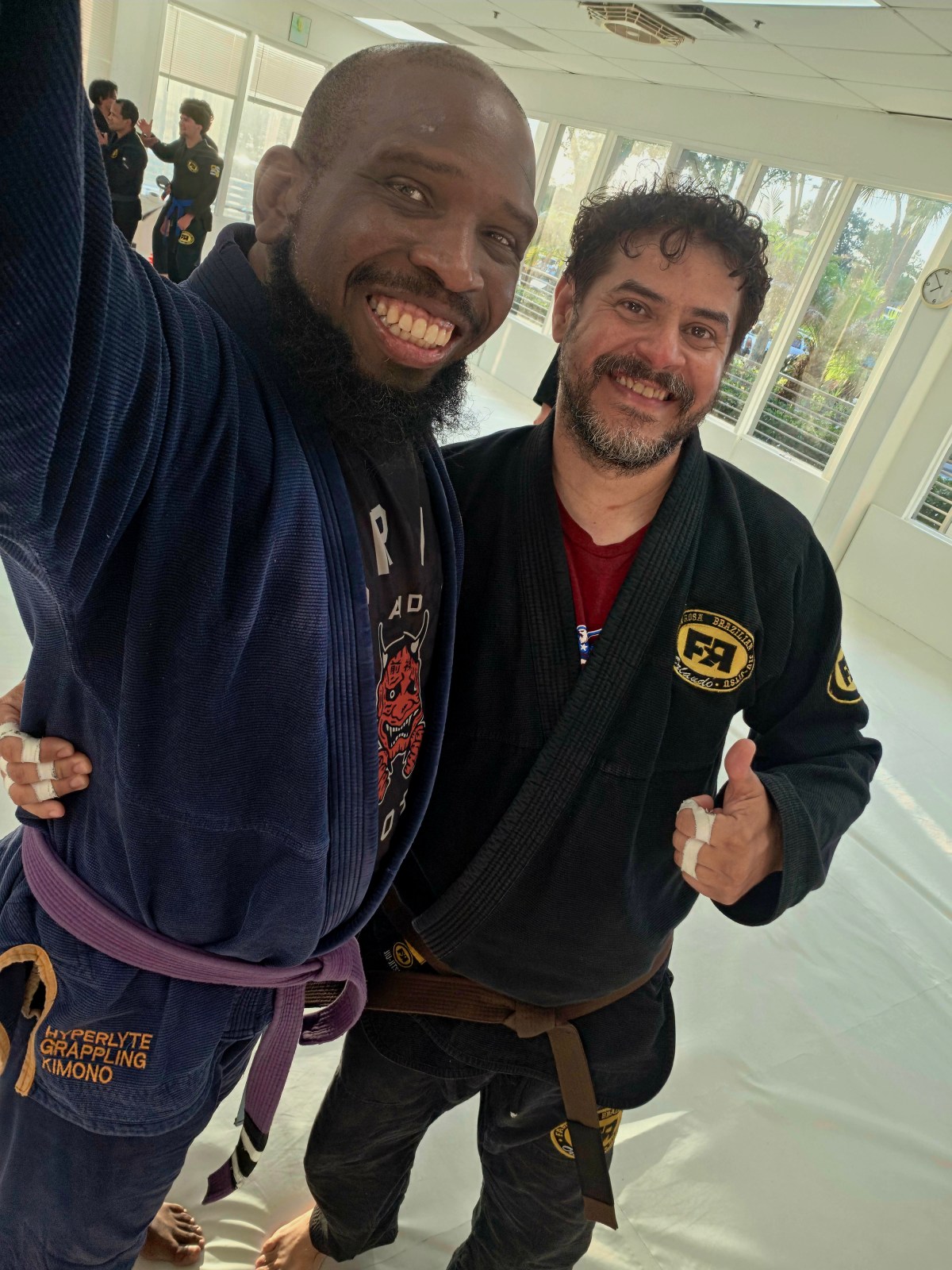
Promotion nights are supposed to feel good.
People clap. Teammates smile and congratulate each other. Coaches tie new belts around waists that have spent months or years earning them. There are pictures, hugs, handshakes, and plenty of jokes about being a sandbagger or quitting now that someone has gotten their blue belt.
But promotion nights can also bring out another emotion that people do not always want to admit.
Disappointment.
I noticed it recently when several people at our academy were promoted. Most of the room was celebrating, but one of our white belts looked discouraged that his name had not been called.
I understood it. He watched as other white belts he trained with got promoted to blue and it made him question, “Why not me”. Heck, that same night one of my favorite teammates got promoted to brown belt and I didn’t, but it didn’t bother me because as a purple belt, I’m in no rush. I know I have things I need to work on and enjoy the process of being a purple belt. But also, I know it’s different for white belts. It’s different because white is the beginner belt and if you’ve been training for over twelve months or so, you may start to feel like you’re no longer a beginner and deserving of the next level.
Even when we are genuinely happy for our teammates, it can still hurt to watch someone else receive something we have been hoping for. We clap for them, shake their hand, and tell them congratulations, while a quieter voice inside us asks:
What about me?
Comparison Comes Naturally
Jiu Jitsu is full of comparison.
We compare how long we have been training. We compare how often we attend class. We compare who taps whom, who competes, who learns faster, and who seems to get more attention from the coaches.
Promotions make those comparisons harder to ignore because the difference becomes visible.
Yesterday, you and your teammate were both white belts.
Today, one of you is wearing blue.
It is easy to look at that moment and turn someone else’s promotion into a judgment about your own progress.
Maybe the person who got promoted started after you.
Maybe you believe you give them difficult rounds.
Maybe you attend just as often.
In case of this white belt in particular, I know a big part of it is his attitude when it comes to losing rounds and matches. Jiu Jitsu is a humbling sport and it can make you a very humble person.
Maybe you have already convinced yourself that you were ready.
That is when disappointment can quickly become resentment.
Instead of thinking, They earned that, we begin thinking, Why them and not me?
That reaction is human, but it is also something we have to be careful with.
Someone else’s promotion is not proof that you are failing.
Their progress does not erase yours.
You Never Know the Whole Story
One of the problems with comparison is that we usually compare what we can see while ignoring everything we cannot.
You may see someone receive a belt, but you may not see the extra classes they attend, the questions they ask after training, or the improvements the coach has noticed over time.
You may not know how consistently they have trained, how they respond to coaching, how they treat newer students, or how much their understanding of Jiu Jitsu has grown.
You also may not fully understand what your own coach expects from you.
Different students need different things.
A younger athlete may be judged partly on pace, competition performance, and physical execution. An older hobbyist may be measured more heavily on technical understanding, consistency, composure, and safe training.
One person may need to become more aggressive/assertive.
Another may need to calm down.
One student may need better offense.
Another may need to stop relying on strength.
That is why two people can train for a similar amount of time and still be on different promotion timelines.
The belt is the same.
The path to it is not.
The Belt Can Become Too Important
There is nothing wrong with wanting to be promoted.
Belts matter.
They represent achievement, recognition, and years of work. Anyone who says belts mean absolutely nothing is probably oversimplifying things.
But problems begin when the belt becomes the only evidence we accept that we are improving.
A student may be escaping positions that used to trap him.
He may be breathing more calmly under pressure.
He may be learning how to protect himself, control his energy, and recognize submissions before it is too late.
He may be becoming a better teammate.
But if his belt remains white, he may convince himself that none of that growth counts.
That is the trap.
Jiu Jitsu gives us many promotions before anyone changes the color around our waist.
The first time you survive a round without panicking is a promotion.
The first time you successfully use a technique you have been drilling is a promotion.
The first time a brand-new student asks you for help is a promotion.
The first time you lose a round without making excuses is a promotion.
Nobody gathers the academy together to recognize those moments, but they matter.
They are signs that you are becoming a better grappler, even when there is no ceremony.
What Do You Do With the Disappointment?
Telling someone not to feel disappointed usually does not help.
You cannot always control the first emotion that shows up.
You can, however, decide what you do next which is more important.
You can become bitter, withdraw from your teammates, and convince yourself that the coach does not see you.
Or you can use the disappointment as information.
Ask yourself honest questions.
Am I training consistently?
Am I listening to coaching?
Am I trying to learn, or am I only trying to win rounds?
Do I rely too much on strength, speed, or one favorite position?
Am I helping create a healthy training environment?
You can also respectfully ask your coach what areas you should focus on. Not to argue your case or demand an explanation, but to gain direction.
A good question is not, “Why didn’t I get promoted?”
A better question is, “What do you think I need to improve to reach the next level?”
One question comes from entitlement.
The other comes from humility.
Your Timeline Is Still Yours
It can be difficult when everyone else seems to be moving forward while you feel stuck.
That feeling is not limited to Jiu Jitsu.
We feel it when friends get married, coworkers receive promotions, other writers publish books, and people our age appear to be farther ahead in life.
But someone else reaching a milestone does not mean you missed your chance.
It does not mean you have been forgotten.
And it does not mean your work has been wasted.
Your job is not to control when the belt comes.
Your job is to keep becoming the kind of student who is ready when it does.
Keep training.
Keep asking questions.
Keep improving the parts of your game that nobody applauds.
Celebrate your teammates, even when part of you wishes it were your turn.
Your disappointment does not make you a bad teammate.
What you do with it determines what kind of teammate and what kind of martial artist you are becoming.
Everyone else may have gotten promoted.
That does not mean your time is not coming.
It only means your work is not finished yet.

 Grappling with Jiu-Jitsu