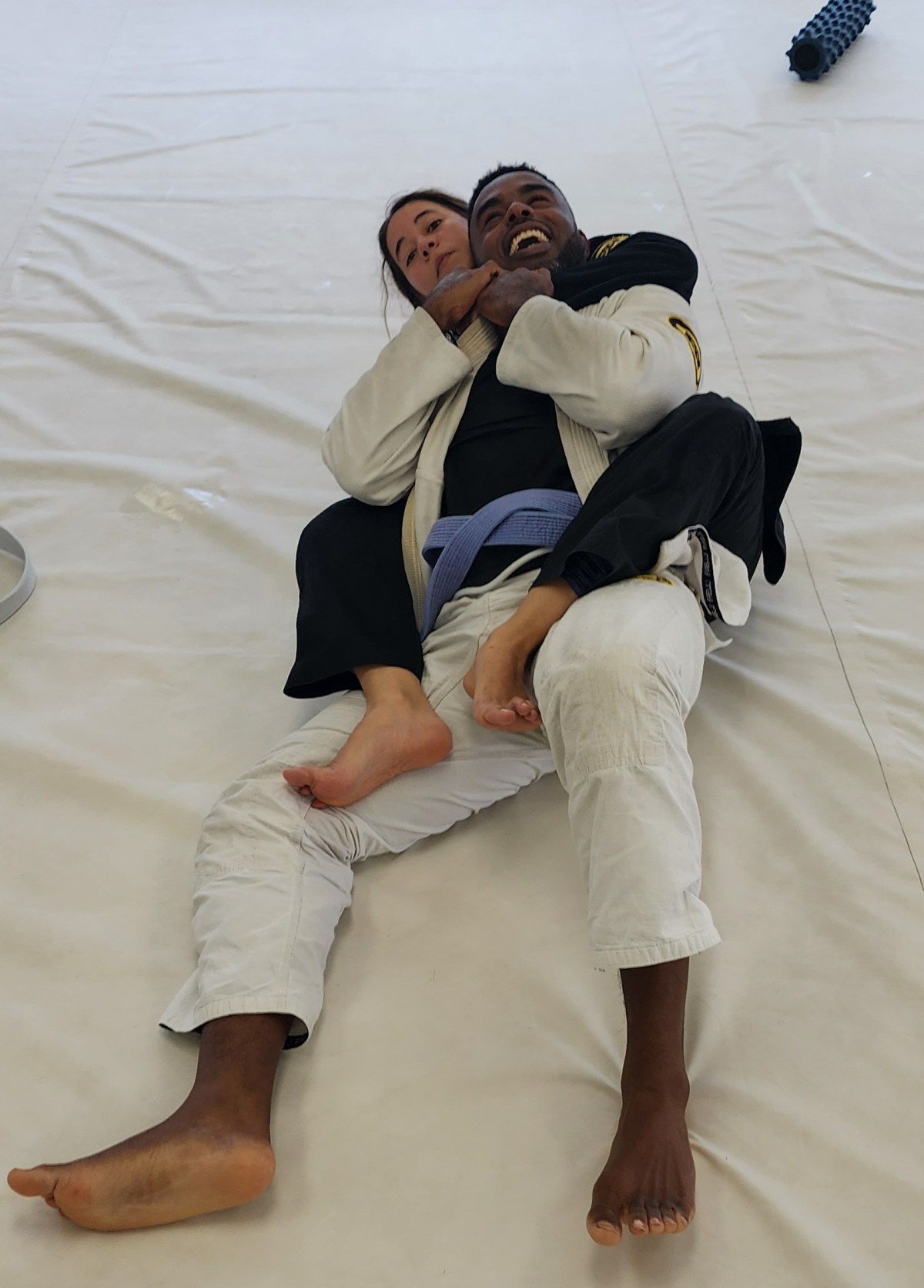
Grappling With My Hematoma: When the Fight Goes Beyond the Mat

Sometimes the toughest opponent doesn’t wear a gi. It doesn’t slap and bump. It doesn’t tap out. Sometimes, the fight is with your own body and the only mat is the one you’re forced to stay off of.

The Onset

It started like so many other injuries in this sport do, with something that didn’t seem like a big deal. A little pain, a little swelling. Maybe just the aftereffects of a hard roll. But this time was different. I didn’t pay it much attention and kept rolling until one day after an open mat someone pointed out my ear had swollen up.  

And that’s when I knew: this wasn’t just a bruise. It was something more.

The Diagnosis

When I finally went to get it checked out, I was met with a word I wasn’t expecting: hematoma.
A collection of blood pooling in the muscle tissue. A reminder that the body has its own limits, even when the mind is still chasing the next belt, the next stripe, the next roll.

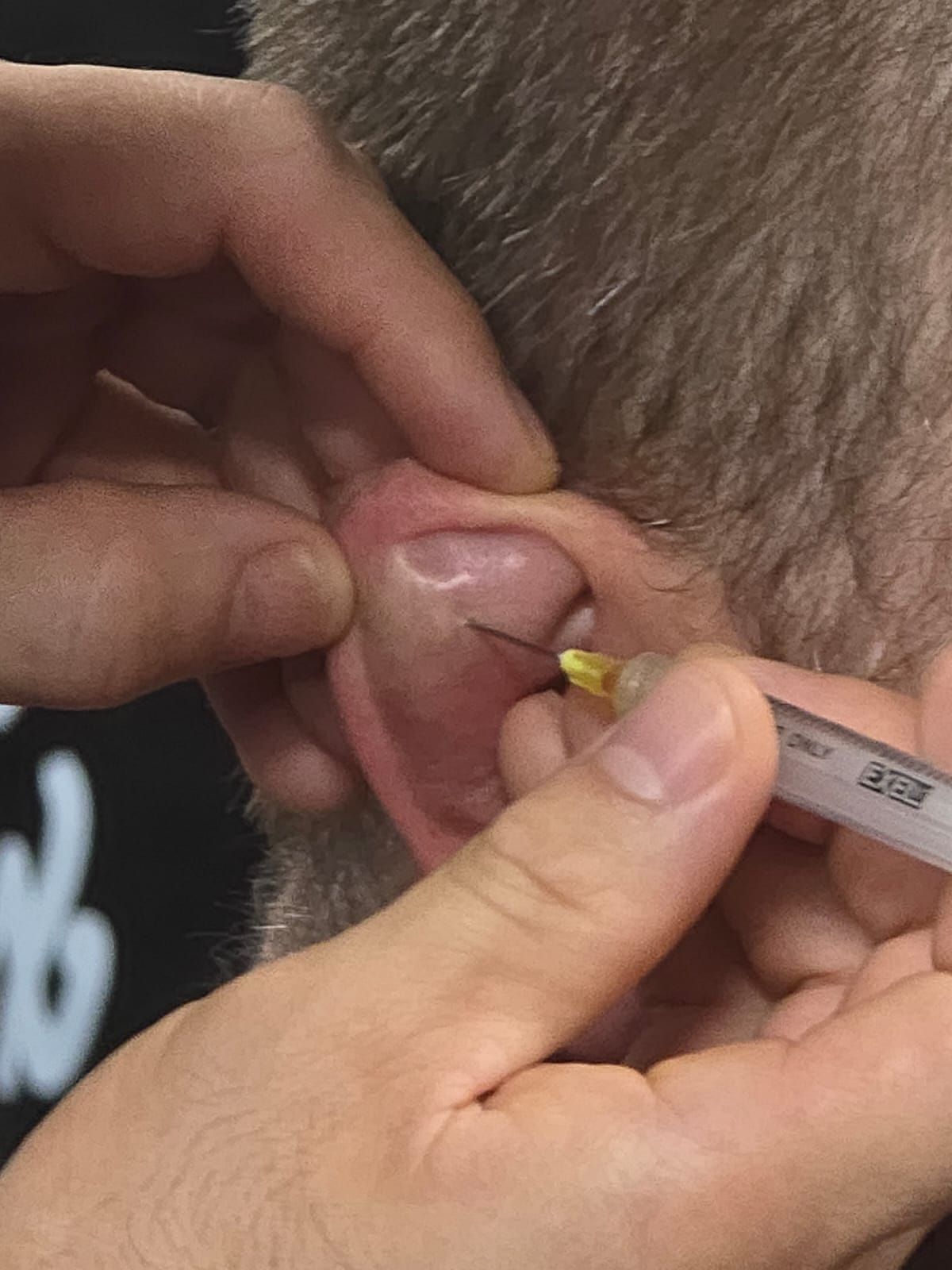
The doctor’s advice? Get it drained. Compressed. Ice. Rest. No training. Elevation. All the usual stuff that sounds simple until you realize what it really means: time away from the thing that keeps you grounded.

Ear hematomas are common in grappling and often lead to cauliflower ear. Some grapplers wear it like a badge of honor and I get that. But I wasn’t ready for the look. Having this happen to me for the first time in over six years of training caught me completely off guard.

The Mental Toll

What caught me off guard wasn’t the physical pain. It was the mental stillness. The way the days felt slower without the rhythm of training. The way the feelings I had used training to quiet came rushing back in. Sadness. Insecurity. Loneliness.


BJJ isn’t just exercise for me. It’s therapy. It’s where I process life, release tension, find clarity.

And without it, the silence crept in.
The doubts.
The restlessness.
The subtle fear that I might lose progress or worse, lose part of myself.

Recovery As a New Kind of Roll

Overtime, I realized recovery is its own kind of training.
You need patience. You need body awareness. You have to let go of ego. You have to listen.
Every time I resisted rest, I prolonged the healing. Every time I honored it, I took a step toward returning.

So I started to treat recovery like a roll: stay calm, breathe, don’t force the position. Adapt to what’s in front of you.

What I’ve Learned

This hematoma taught me that resilience isn’t just about pushing through, it’s also about knowing when to pause.
It taught me that slowing down doesn’t mean stopping.
That healing is a part of training. To trust my body.
And that sometimes, the most important grappling match is the one happening within.

Still Grappling

I’m still healing. Still learning. Still grappling (with headgear until it’s 100%).
But I have a deeper respect for my body, my mind, and the balance between drive and rest.

Because the mat will always be there.

The Role of Good Training Partners in Sharpening Your Game

There’s a saying in Jiu Jitsu: iron sharpens iron. But iron doesn’t sharpen itself. it needs resistance, friction, and the right kind of partner.

In a sport where it’s easy to obsess over your own belt, your own progress, and your own survival on the mat, it’s easy to forget that growth isn’t a solo mission. Your coaches can guide you, but it’s your training partners who shape you day after day. They are your mirrors, your measuring sticks, your silent coaches. Unlike some martial arts, it’s impossible to truly learn and level up in Jiu Jitsu alone.

I’ve come to realize the people I train with aren’t just bodies to drill with, they’re essential to my progress.


Good Training Partners Make You Better. Here’s How

The best training partners:

  • Give honest feedback. They’ll tell you when your defense is sloppy, when your arm’s in danger, or when you’re telegraphing your next move. They don’t let you build bad habits.
  • Expose your blind spots. They don’t let you stay comfortable. They find the holes in your game and help you see them.
  • Push you at your edge. They roll just hard enough to test you, but not to break you. They meet you where your growth happens.
  • Trust you enough to correct you. Feedback isn’t always easy to give. Good partners risk awkwardness to help you.
  • Stay consistent. They keep showing up, even as you start getting better. They’re not just there to win. They’re there to grow with you.

Signs You’ve Got a Good Training Partner

You know you’ve got a good one when:

  • They roll to help you grow, not to just dominate you all the time.
  • They can give and receive feedback without getting defensive.
  • They’ll say, “Hey, you’re leaving your arm out there.”
  • They don’t avoid rolling with you when the rolls get harder as you improve.
  • They ask, “What are you working on? Want to rep that?”

How to Be a Good Training Partner

It’s a two-way street. Here’s how to give what you hope to get:

  • Ask after a roll: “What did you notice? Anything I can work on?”
  • Offer specific, helpful feedback: “You kept leaving space when you passed on that side.”
  • Roll with people at all levels. Don’t just chase tough rolls or easy wins.
  • Help newer students feel welcome. Share what’s been shared with you.
  • Say thank you. Seriously. “Thanks for that roll—that showed me what I need to work on.”

A Personal Story

Just last week I went to a noon No-Gi class and rolled with some guys I generally don’t get to roll with as I usually go to night classes. These guys were tough. Their styles were similar because they train together often and their game was what my game is (pass and smash) except… better. They called me out for being on my knees too much and not generating enough pressure. They called me out for violating the toe control rule, or whatever it is called. I had never hard of it before that, but it’s when trying to pass an opponent in open guard. I kept getting too close to my opponent with my feet without first establishing grips. Feel free to clarify this for me if you know more, but it was and is still new to me. They also called me out for other small holes I have in my game, but it was the first time in a long time someone had called out my weaknesses so specifically. I mean, I knew I had weaknesses in my game, but it was great to have someone else call them out and offer sound advice to start fixing it. I left that training session feeling invigorated and ready to start working on closing those holes and appreciative of those two guys for pushing me and pointing them out to me.


Closing

Good training partners don’t just help you survive the next roll, they help you evolve. They sharpen your game, your awareness, and your ability to stay humble. If you’ve found people like that in your gym, keep them close, appreciate them, and do your part to be that person for someone else.

Because in Jiu Jitsu, we don’t grow alone. We grow together.

The Calm After the Storm: How Jiu Jitsu Grounds You After a Long Day

No matter how exhausted I am after getting off from work, I can usually find the strength to drag myself to class. There’s something about stepping onto the mat after a long day that feels like an exhale your body has been holding onto for hours.

For many of us, the day begins in chaos, waking up groggy, shuttling kids off to school, facing the noise and demands of work, feeling pulled in a dozen different directions. By the time we get off work, our nervous systems are fried, and our minds are running in loops. That’s where Jiu Jitsu comes in.

When people talk about Brazilian Jiu Jitsu (BJJ), they often highlight its intensity, its competitiveness, and the physical toll it takes. But what doesn’t get talked about enough is the calm that follows the storm, the way training can settle a restless mind and anchor you to the present.

The Reset Button

Walking into the gym is like stepping into a completely different reality. You strip off the titles, the expectations, and the stress. Whether you’re a therapist, a parent, a nurse, or a construction worker, once you tie that belt, you’re just another person on the mat.

The physical exertion of drilling and sparring forces you to be fully present. There’s no room to worry about unpaid bills or unresolved arguments when someone is trying to pass your guard or lock in a choke. Your survival instinct kicks in, but in a safe, controlled environment. This, in itself, is therapy.

You move from fight-or-flight to focus and flow.

Why the Calm Feels So Good

Most of the time I leave Jiu Jitsu feeling so much lighter than I did when I first walked in, and I’m not just talking about the water weight I lost from sweating. It’s one of the main reasons I push myself to go, especially after a particularly hard day.

From a mental health perspective, training BJJ activates several key systems in the body. You get a surge of endorphins, your cortisol levels begin to drop, and you start to regulate your breathing. When you finish class, the same problems might still exist, but your relationship to them has shifted. They’re no longer screaming in your face.

And for those of us who struggle with anxiety, depression, or even burnout from emotionally demanding work, Jiu Jitsu becomes more than a workout. It becomes a lifeline.

Returning to the Body

So much of life keeps us trapped in our heads. We replay conversations, obsess over what we could have said or done differently, and catastrophize about the future. But when you train, you return to the body. You start noticing your breath. You begin to feel the rhythm of movement. You learn to read your training partner’s body language, and in doing so, you become more attuned to your own.

This somatic awareness is healing. Trauma, stress, and emotional pain often live in the body (check out The Body Keeps The Score if you’re really interested in learning more about that) and Jiu Jitsu creates a space for them to move, to be expressed, and eventually, to be released.

The Post-Roll Stillness

There’s a particular kind of stillness that settles in after a hard roll. Your muscles are spent, your gi is soaked, and your heart rate begins to slow. You lie on your back, looking up at the ceiling, breathing deeply. That stillness isn’t just physical, it’s emotional. It’s spiritual.

In that moment, you’re not thinking about tomorrow’s tasks or yesterday’s regrets. You’re just… here. Alive. Present. At peace.

Taking It Off the Mat

The calm after class doesn’t have to stay at the gym. It can bleed into how we parent, how we show up in relationships, and how we manage stress. The more consistent we are with training, the more we begin to carry that grounded presence into everyday life.

Jiu Jitsu won’t fix all your problems. But it can help you meet them from a place of strength, clarity, and emotional balance.

So the next time you’ve had a day that leaves you feeling wrecked and disconnected, step onto the mat. Let the storm of training clear away the debris. And let the calm after remind you of who you are beneath the stress.

You’re more than what happened to you today. You’re a fighter. And fighters know how to find peace in the middle of chaos.

As for morning class people? Well, it definitely takes a special kind of person to wake up and train at 6am 🙂

The Power of Patience: Embracing the Slow Grind in Jiu Jitsu


Jiu Jitsu is often described as a “slow grind “and it teaches us one of the most valuable life lessons: the power of patience. Progress in this martial art is rarely quick or easy. Unlike some sports where immediate results are common, Jiu Jitsu requires long-term dedication, focus, and the ability to keep going even when it feels like you’re not improving.

The journey of learning Jiu Jitsu is a marathon, not a sprint. It’s not about instant gratification; it’s about the consistent, steady effort that leads to growth. Whether you’re rolling with a seasoned upper belt or struggling through a tricky submission, you quickly learn that each step in Jiu Jitsu, no matter how small, is a victory.

Embracing the Slow Grind of Jiu Jitsu

When you first start Jiu Jitsu, it can be overwhelming. The techniques seem complicated, the positions confusing, and the tapping out inevitable and often. You might feel like you’re stuck in a cycle of repeating the same drills without seeing significant improvements. But over time, this repetition is where the magic happens. You begin to notice the subtle shifts in your body’s movements, the increase in your strength and endurance, and the sharpening of your mental focus.

One of the beautiful things about Jiu Jitsu is that it forces you to embrace the process. You can’t rush through learning. The guard sweeps, submissions, and escapes that once seemed impossible eventually become second nature. Not because you pushed harder, but because you allowed yourself the time to truly understand each detail. This kind of progress doesn’t happen overnight, but it’s a profound realization when you realize how far you’ve come after months of patient practice.

There’s one thing I find myself telling new student’s often: “Don’t quit”. I can see the frustration in their face, in their body language and I get it. I was there. Overwhelmed. Exhausted. Confused. Defeated. You feel like it will always be like this, but the truth is, it won’t. Not if you stick with it and be patient.

Why Patience is Key

Patience is the key to unlocking Jiu Jitsu’s full potential. It teaches you that nothing worth having comes instantly. Progress in Jiu Jitsu is measured in small increments. Today, you might master a single detail of a technique, and tomorrow, you may struggle with the same technique again. But through persistence, those incremental victories build up over time, and before you know it, you’re executing complex movements without thinking.

This is where Jiu Jitsu mirrors life. The challenges we face aren’t always going to be solved in a single day or with a quick fix. Whether it’s in your career, relationships, or personal goals, success comes from the ability to show up consistently, day after day, despite not seeing instant results.

The Mental Benefits of Patience in Jiu Jitsu

Jiu Jitsu’s slow grind has profound mental benefits that extend beyond the mat. The ability to embrace the process teaches mental resilience, focus, and self-discipline. It shows you that setbacks are a natural part of growth. When you tap or fail at a technique, it’s not a reflection of your worth, it’s an opportunity to learn, adapt, and try again.

This mindset helps with emotional regulation, especially during stressful situations. Just like in Jiu Jitsu, when life throws challenges your way, practicing patience allows you to approach each obstacle with a clear and steady mind. You begin to see failure not as an end, but as a part of the journey, something to learn from, not something to avoid.

Patience Beyond the Mat: Life Lessons Learned from Jiu Jitsu

One of the most powerful aspects of Jiu Jitsu is how it teaches us patience that applies to all areas of life. Whether you’re facing a tough situation at work, navigating personal struggles, or simply trying to improve your fitness, the lessons learned on the mat: consistency, resilience, and slow, steady effort, are incredibly valuable.

Jiu Jitsu has a way of humbling you. You quickly learn that there’s no shortcut to mastery, and the same is true in life. The more you focus on putting in the work and being patient with yourself, the more you’ll grow, not just as a martial artist, but as a person.

Tips for Embracing the Grind in Jiu Jitsu

  1. Set Small Goals: Focus on mastering one technique or position at a time. Celebrate small victories, and don’t rush the process.
  2. Be Consistent: Show up regularly, even when you feel like you’re not progressing. The consistency will pay off in the long run. You don’t have to kill yourself by training everyday, but pick at least two or three days out of the week and be consistent.
  3. Reflect on Progress: Take time to look back at where you started and appreciate how far you’ve come. Tracking your journey can boost morale during tough times.
  4. Accept Setbacks: Understand that setbacks are normal. Don’t let temporary frustration derail your progress. Embrace each challenge as an opportunity to grow.
  5. Patience with Others: Be patient with your training partners as well. Everyone is on their own journey, and you’ll learn just as much by helping others as you will by focusing on your own growth.

Jiu Jitsu teaches us that patience is not just a passive waiting game, it’s an active part of the learning process. The slow grind is not something to fear but to embrace. The more we practice patience on the mat, the more we unlock the deeper lessons that Jiu Jitsu offers, lessons that go beyond technique and strength, and into the realm of mental and emotional resilience.

As you continue your Jiu Jitsu journey, remember that the slow grind is not a sign of stagnation but part of your growth. Every roll, every drill, and every tap out is a step forward, no matter how small it may seem in the moment. So, take a deep breath, enjoy the process, and trust that with each passing day, you’re getting closer to your goals.


WILL BJJ (BRAZILIAN JIU-JITSU) MAKE ME MORE MENTALLY TOUGH?

The other day I was on a forum where someone asked the question, “Wil BJJ make me more mentally tough?”. Unfortunately, the person who posed this question got a bunch of sarcastic responses but as a licensed mental health counselor and someone who observes various forms of resilience and mental conditioning, I find this topic intriguing. So, does practicing BJJ actually contribute to mental toughness? Let’s explore.

What Do We Mean by Mental Toughness?

First things first. Mental toughness refers to the resilience and strength that help individuals cope with stress, pressure, and challenges. It’s about overcoming fears and inhibitions and performing at your full potential, even when circumstances aren’t ideal. It’s a broad term, encompassing emotional control, self-belief, and the ability to bounce back from setbacks.

The Physical-Mental Connection

In BJJ, physical exertion is a given. The movements are complex, the pace can be fast, and you’re often in physically uncomfortable positions. However, the mental aspect is as engaging, if not more so, than the physical one. It requires a level of concentration, strategic thinking, and problem-solving that is akin to a fast-paced, interactive chess match. This deep mental engagement is often cited by practitioners as a training ground for broader life challenges.

Facing Fears Head-On

Being pinned to the ground or being put in a chokehold can be terrifying experiences. BJJ thrusts you into these uncomfortable situations and forces you to confront your fears directly. The repeated exposure to such stressors can desensitize you to them over time, allowing you to think clearly under pressure—both on the mat and in life.

Emotional Control

A roll (sparring session) in BJJ can be both exhilarating and frustrating. Your emotions can swing from one extreme to the other in a matter of minutes. Learning to maintain your composure in such a volatile environment can be incredibly beneficial. Emotional control doesn’t mean suppressing feelings; rather, it’s about acknowledging them and choosing a rational course of action. This is a key facet of mental toughness and is highly transferable to other areas of life, such as work, relationships, and personal challenges.

Learning from Failure

In BJJ, you will lose—a lot. Even the most skilled amongst us find themselves in compromising positions and get tapped out. What makes BJJ a catalyst for mental toughness is the approach to these losses. There’s a culture of learning from your mistakes, analyzing what went wrong, and coming back stronger. This positive approach to failure fosters resilience, another cornerstone of mental toughness.

Setting and Achieving Goals

BJJ is structured around a ranking system, and each rank has its own set of techniques and competencies that need to be mastered. Setting your sights on the next rank and working diligently to achieve it instills a sense of purpose and promotes self-discipline. The process of setting, working toward, and achieving these micro-goals can be a significant booster for your mental toughness.

Social Support and Community

Lastly, the community aspect of BJJ should not be underestimated. Training together and pushing each other toward improvement creates a sense of belonging and collective resilience. The social interaction and mutual encouragement can be powerful mental health boosters.

Conclusion

While no activity can magically give you mental toughness, BJJ does offer a conducive environment for its development. Through its unique combination of physical challenges, emotional volatility, and strategic complexity, Brazilian Jiu-Jitsu can be a powerful tool for building resilience, enhancing emotional control, and honing your ability to adapt and overcome.

I for one definitely have been able to handle life stressor a lot better since I started training Jiu Jitsu and it’s not just the confidence I feel to defend myself and those I care about, but the confidence to conquer fears and step out of my comfort zone.

So, will BJJ make you more mentally tough? The evidence points to a resounding yes, but like any form of personal development, the results you get are directly proportional to the effort you put into it.

The Blue Belt Chronicles: A Journey of Growth and Self-Discovery

The blue belt – a symbol of progression from the beginner’s white and a mark of recognition that you’ve stepped onto the long road of mastering Brazilian Jiu Jitsu. But as many practitioners will attest, being a blue belt is so much more than a step above white. It’s a phase of self-reflection, challenges, and immense growth.

The Initial Euphoria

Receiving the blue belt is an exhilarating experience. The countless hours spent learning the basics, getting tapped out by almost everyone, and the bruises and aches – they all seem worth it when that blue fabric wraps around your waist. It’s a public acknowledgment of your dedication, hard work, and improvement. But beyond that initial euphoria lies a path filled with introspection and challenges.

Embracing the ‘Blue Belt Blues’

The “blue belt blues” is a phrase often whispered in BJJ circles. It’s that phase where the initial excitement has faded, the journey to the next belt seems daunting, and the weight of expectations bears down. As a blue belt, you’re no longer a newbie, but you’re also not a seasoned practitioner. It’s an in-between phase, where the mental battles often overshadow the physical ones.

But it’s essential to remember that this phase, like every challenge in BJJ, is about growth. The blues become a mirror, reflecting our fears, insecurities, and doubts. Facing them head-on, acknowledging them, and persevering through this phase is what shapes a resilient BJJ player.

A Time for Consolidation

While the white belt phase is about exposure to a plethora of techniques, the blue belt stage is about consolidation. It’s about refining the basics, understanding the nuances, and developing a game plan. But this consolidation isn’t just physical.

Mentally, it’s about understanding who you are on the mat. Are you aggressive or defensive? Do you rely on strength or technique? Are you a guard player or do you prefer being on top? This self-discovery is as much a mental journey as it is a physical one.

The Weight of Responsibility

With a new belt comes new responsibility. As a blue belt, you become a beacon for white belts. They look up to you, observe your techniques, and often come to you with questions. This added responsibility can be daunting but it’s also an opportunity. Teaching and helping others not only consolidates your knowledge but nurtures empathy and patience, qualities essential both on and off the mat.

Overcoming Plateaus

Every blue belt faces plateaus – those frustrating periods where progress seems stagnant. It’s easy to feel disheartened, to question one’s abilities during these times. But these plateaus are mental tests. They teach grit, patience, and the importance of consistent effort. Overcoming them requires a shift in perspective, focusing on the journey rather than the destination.

Conclusion: Embracing the Journey

Being a blue belt is a mixed bag of emotions. It’s exhilarating, challenging, frustrating, and rewarding, all at once. But more than anything, it’s a phase of profound growth and self-discovery. It prepares the practitioner, not just for the next belt, but for the challenges of life. It instills resilience, patience, self-awareness, and an unwavering spirit.

Every time I tie my belt around my waist, I’m reminded that it’s not just a rank, but a representation of a journey. A journey filled with falls and rises, taps and victories, doubts and epiphanies. And as with any journey, it’s not the destination but the experiences, learnings, and memories that truly matter most.

Beyond the Belt: The Mental Growth in Jiu Jitsu Promotions

When most people think about belt promotions in Jiu Jitsu, they envision mastered techniques, grueling rolls, and visible skill progression. While all these elements play an important role in our journey from one belt to another, there’s another equally important facet: the mental and emotional growth accompanying each promotion.

The Introspective Start

When I first put on the white belt, the world of BJJ was filled with raw enthusiasm, confusion, and endless learning. Every technique was a puzzle, every roll an exercise in humility. But it wasn’t just about understanding the techniques; it was a journey of introspection. As I grappled with opponents, I also grappled with my insecurities and doubts.

I was getting beat by everyone. It didn’t matter their age, weight, gender or athletic attributes. I came in thinking I was in shape. I lifted weight 4 to 5 days per week. I could bench press over 315lbs. None of that matter when I realized I didn’t have the conditioning to last 5 minutes grappling. I definitely had a reality check that shocked me and yet made me want to get better.

Unfortunately, a lot of new students when faced with the reality that they aren’t as good as they may have thought they were in their heads, quite before they have an opportunity to get better. It’s something about those that keep showing up, despite it all, that separates them from 99% of the world. The beautiful thing is, it has nothing to do with how tough they are, or how athletic they are. Some of them are soccer mom’s or introverted techys you’d never imagine would choose a sport as physically demanding as Jiu Jitsu for a hobby.

Blue Belt Blues and Mental Fortitude

When I was a white belt, I remember wanting to make it to blue, mostly because it would signify that I didn’t give up when many others had and especially when I wanted to.

Earning my blue belt was a monumental moment of pride, but it came with its unique challenges. The white belts seemed to come at me harder and the upper belts weren’t as gentle. On top of that, I wasn’t a newbie anymore so it felt like I couldn’t keep making stupid mistakes and blame it on me being a white belt.

Making it to blue was great but there is a lot of reasons many blue belts quit. Often referred to as the “blue belt blues,” this phase became a test of dedication. The initial excitement of starting BJJ had faded, and black belt seemed light-years away. It was during this phase that mental fortitude became important, and I learned to stop focusing on belts and just put my head down and grind.

More than techniques or skills, it was about showing up, even when I wasn’t motivated. It was about facing and acknowledging the self-doubt and then choosing to persevere. My teammates became even more important to me, more like family. They held me accountable to show up and train. Whenever I felt like quitting, unmotivated, like I as stuck, going backwards or downright sucked, my training partners uplifted me and challenged me to push through. I learned to have fun and to enjoy being a blue belt. I learned to embrace the grind.

Purple Belt: Embracing the Mental Complexity

About a month ago I was awarded my purple belt and it felt like stepping into a new realm. Initially I didn’t even want to be promoted. I felt like I wasn’t ready and I had learned to embrace being a blue belt. I didn’t want the pressure I felt came with being a purple belt.

Not only was there an expectation to refine techniques and showcase fluidity in movements, I felt pressure to be better than I thought I was. After talking to my coaches and some of my teammates, that initial anxiety wore off. I realized that being a purple belt meant I needed to have a shift in mental complexity.

There was an unspoken understanding that being a purple belt wasn’t just about what I did on the mats, but how I thought and felt. Emotions had to be regulated, strategies had to be formed, and mental agility became as crucial as physical agility.

As a purple belt, you’re often looked up to as a mentor and one of the leaders in the academy. Lower belts are watching you, not just how you roll but how you approach training, respect others and respect the art. You should be a good role model while also challenging yourself to be better on and off the mats.

One crucial aspect of this mental growth is the acceptance of imperfection. No matter the belt color, there will always be failures, mistakes, and missed opportunities. The purple belt phase reinforces the idea that growth often comes from acknowledging our flaws and continuously working on them.

So far, I am enjoying this phase. I am pushing myself to be more competition minded, even when not competing. I’m even more open to learning to be a better practitioner and more willing than ever to help others improve as well.

Anticipating the Future: The Road Ahead

As I think about the journey ahead – brown and, eventually, the coveted black belt – I recognize that the challenges will evolve. They’ll demand more than just technical prowess. They’ll require mental resilience, emotional intelligence, and an ever-present passion for the art. I anticipate moments of introspection, self-doubt, euphoria, and profound learning. And I believe that the mental and emotional growth I’ll experience will be as valuable, if not more so, than the physical.

Staying connected with my teammates will always be invaluable. Without them I would have never made it this far.

Conclusion

The belts we tie around our waist in Jiu Jitsu signify more than just technical abilities; they represent chapters of growth, both physical and mental. With each promotion, we don’t just become better martial artists; we become more resilient, introspective, and emotionally intelligent individuals. The journey is challenging, no doubt, but every obstacle, every moment of self-doubt, and every victory makes us not just better fighters but better individuals.

Tackling Competition Anxiety: Finding Calm in the Eye of the Storm

Every time I sign up for a competition, I immediately become anxious. That anxiety only increases the closer I get to competition day and builds up to the point that there have been times I thought I would pass out before I even made it to the competition that day. Thankfully that has never happened.

That’s part of the beauty of competition. Pushing yourself beyond your comfort zone even when every fiber of your being is telling you not to do it. Chances are that the opponent standing across from you is going through the exact same thing.

The fluttering in the stomach, the rapid heartbeat, the sweaty palms – these are familiar sensations for many athletes preparing to compete. For Jiu Jitsu practitioners, the intimate, strategic nature of the sport can amplify these feelings, making competition anxiety a formidable opponent even before stepping on the mat. Recognizing and effectively managing this anxiety is one key for optimal performance.

Understanding Competition Anxiety

At its core, competition anxiety stems from fear – fear of failure, judgment, or even success. It’s the body’s natural response, gearing up to face a perceived threat. However, when unchecked, it can cloud judgment, hamper decision-making, and hinder performance.

A. Physical Symptoms: Increased heart rate, rapid breathing, nausea, and dizziness.
B. Psychological Symptoms: Doubt, hyper-awareness, loss of focus, and intrusive thoughts.

Root Causes of Anxiety in BJJ Competitions

  1. Fear of Public Failure: With spectators watching, not to mention your teammates, coaches, friends and even family members, there’s pressure to succeed, making the fear of public embarrassment a significant stressor.
  2. High Expectations: Whether self-imposed or from peers and coaches, high expectations can be paralyzing.
  3. Mental Stakes: Competitions can feel like a direct reflection of our skills, self-worth, and months of training, amplifying the pressure.
  4. Unpreparedness: A lack of preparation, physically or mentally, can spike anxiety levels.

Strategies for Alleviating Competition Anxiety

A. Embrace the Anxiety

  • Recognize that some level of anxiety is beneficial. It sharpens reflexes and enhances focus. Instead of trying to eliminate it, try harnessing it. Remember, physiologically, there is no difference between anxiety and excitement so keep telling yourself that you’re excited instead of saying your anxious.

B. Visualization Techniques

  • Close your eyes and visualize the entire competition process: arriving at the venue, warming up, stepping onto the mat, executing moves, and ultimately, achieving success.
  • This mental rehearsal not only prepares the mind but also boosts confidence.

C. Deep Breathing & Grounding Techniques

  • Deep, controlled breathing can slow the heart rate and clear the mind.
  • Grounding exercises, like the “5-4-3-2-1” technique (identifying five things you can see, four you can touch, three you can hear, two you can smell, and one you can taste), can help center you in the present moment.

D. Set Realistic Expectations

  • Not every competition will result in a gold medal.
  • Focus on the journey, the lessons learned, and personal growth.

E. Routine & Ritual

  • Establishing a pre-competition routine or ritual can provide a sense of familiarity and control.
  • Whether it’s a specific warm-up sequence, listening to a particular song/playlist, or wearing a lucky charm, these rituals can anchor your mind.

F. Positive Affirmations

  • Replacing negative self-talk with positive affirmations can alter your mindset. Phrases like, “I am prepared,” “I am strong,” or “I’ve got this,” can be powerful motivators.

G. Stay Present

  • Focus on the process, not just the outcome. Instead of fixating on winning, concentrate on each move, each strategy, and the joy of competing.

H. Preparation

  • The more prepared you are, the more in control you feel. This includes physical training, mental rehearsal, and strategy planning.

Post-Competition Reflection

After the competition, no matter the outcome, take time to reflect:

  1. Assess the Anxiety: Was it more manageable? What techniques worked, and what didn’t?
  2. Acknowledge Achievements: Celebrate small victories, even if they’re not related to the competition’s outcome. Perhaps you managed your anxiety better or executed a technique you’ve been working on.
  3. Develop a Plan: Use the experience to refine your approach for future competitions.
  4. Do something to celebrate yourself: It can be something as small as treating yourself to a dessert you’ve been avoiding due to your weight cut or it could be going out with friends. No matter the outcome, reward yourself for doing what most people will never do.

Conclusion

Competition anxiety is a natural part of the athletic experience, but it needn’t be an insurmountable hurdle. So many practitioners let this anxiety keep them from ever competing. With understanding, preparation, and effective coping techniques, you can transform anxiety from a formidable opponent into a powerful ally. As you face future competitions, remember: the greatest battles are often waged within, and mastering your mind is half the victory.

From Addiction to Arm Bars: How Jiu Jitsu Aids in Substance Abuse Recovery

Over the years I have met a handful of Jiu Jisu practitioners who praised the benefits of Jiu Jitsu in aiding in their recovery efforts or curbing bad habits from everything from alcohol to cigarettes and even hard drugs. I for one, know that once I started training Jiu Jitsu regularly, I no longer had the time or desire for some of my old habits which included frequenting bars and drinking beer multiple nights per week. Those habits did not seem to be conducive to me performing well on the mats and the more I fell in love with training, the more I preferred to be on the mats sweating on any given night than in a bar drinking. That’s why it’s no surprise to me that Jiu Jitsu can definitely aid in helping kick a substance addiction.

Addiction is a chronic, relapsing disorder characterized by compulsive substance use despite harmful consequences. Substance use disorder can wreak havoc on an individual’s physical health, mental wellbeing, relationships, and overall quality of life. The road to recovery from addiction can be daunting and fraught with obstacles. However, the discipline of Brazilian Jiu Jitsu (BJJ), with its unique combination of physical, cognitive, and social components, can offer valuable support in this journey.

Understanding Addiction

To understand how Jiu Jitsu can help in addiction recovery, we first need to delve into the nature of addiction. Addiction is much more than a lack of willpower; it is a disease that affects both the brain and behavior. Long-term substance use can lead to changes in the brain’s structure and function, particularly in areas related to reward, stress, decision-making, and memory.

The Jiu Jitsu Way

Jiu Jitsu is not just a martial art; it’s a physical workout, a strategy game, a form of mindfulness, and a social activity, all rolled into one. Here’s how this multifaceted discipline can aid in the recovery process:

1. Reclaiming the Body

Substance abuse often leads to neglect of physical health. The regular physical exertion in Jiu Jitsu not only improves physical fitness but also cultivates a sense of respect for the body. It helps individuals understand their body’s capabilities and limitations, promoting a healthier relationship with their physical selves.

2. Natural Highs

Physical exercise, like that involved in Jiu Jitsu, stimulates the release of endorphins – neurotransmitters that produce feelings of pain relief and euphoria. This natural ‘high’ can serve as a healthy replacement for the artificial and harmful ‘high’ derived from substance use.

3. Mindfulness on the Mats

Jiu Jitsu requires complete mental engagement. Whether it’s a drilling session or a roll, practitioners need to stay present, focused on their movements and their opponents’. This is mindfulness in action, providing a temporary reprieve from cravings or ruminations about substance use.

4. Building Resilience

Recovery from addiction is a journey filled with setbacks and challenges. Resilience, the ability to bounce back from adversity, is therefore a vital skill in this journey. In Jiu Jitsu, every sparring session, every tap, is a lesson in resilience. Each time a practitioner gets back up after a defeat, they’re building their capacity to handle setbacks – a skill that’s invaluable in recovery.

5. A Sense of Achievement

Mastering a new technique, progressing in belt ranks, or just managing to stay on the mat for a minute longer than before – Jiu Jitsu is filled with measurable achievements. These successes can boost self-esteem and self-efficacy, countering the feelings of worthlessness and helplessness often associated with addiction.

6. The Power of Community

A strong support network is critical in the recovery process. The Jiu Jitsu community, with its ethos of respect and mutual aid, provides this much-needed support. The camaraderie on the mats can help combat the isolation that often accompanies addiction.

Jiu Jitsu: An Adjunct to Traditional Therapy

As a Jiu Jitsu practitioner and someone who has worked as an addiction’s counselor, I know that while the benefits of Jiu Jitsu in addiction recovery are compelling, it’s important to know that it’s not a standalone treatment. It should be seen as a complementary tool, used in conjunction with traditional treatment such as cognitive-behavioral therapy, Motivational Interviewing, medication, and support groups.

As you can see, the discipline of Jiu Jitsu offers more than just physical strength and self-defense skills. It provides a holistic approach to well-being that can support the journey from addiction to recovery. It’s a path that challenges and rewards in equal measure, fostering physical health, mental resilience, and social connection.

In the fight against addiction, every tool matters. And for many, Jiu Jitsu could be a powerful tool – a discipline that not only helps them combat addiction but also equips them with skills and principles that enrich their lives. As Helio Gracie, one of the founders of Brazilian Jiu Jitsu, said, “Jiu Jitsu is personal efficiency to protect the weaker, which anyone can do. It is the force of leverage against brute force.” Perhaps, in the context of addiction recovery, it’s the leverage of discipline, resilience, and community against the brute force of addiction.

Mind, Body, and Gi: The Psychological Benefits of Jiu Jitsu Training


There’s an old saying in martial arts circles: “Black belts are merely white belts who refused to quit.” Beyond the physical prowess and tactical skill that Brazilian Jiu Jitsu (BJJ) practitioners cultivate, it’s the mental fortitude, the grit, that makes this adage ring true. But the psychological impact of Jiu Jitsu extends far beyond perseverance. Through its physical maneuvers, strategic gameplay, and immersive nature, BJJ provides practitioners with a wealth of mental health benefits.

The Power of Now: Mindfulness in Action

Mindfulness, the practice of focusing on the present moment, is a cornerstone of mental well-being. It is often recommended as a tool to alleviate a host of mental health concerns, including stress, anxiety, and depression. The practice of Jiu Jitsu, while physically intense and demanding, is fundamentally an exercise in mindfulness. Whether you’re drilling a technique or engaging in a sparring session, your mind must be entirely present on the mats. You’re focused on your breathing, your movements, and your opponent’s actions. This focused attention on the here and now leaves no room for ruminations about the past or anxieties about the future.

Self-Efficacy and Mastery

Self-efficacy, the belief in our ability to succeed in specific situations, is a crucial aspect of mental health. It influences our motivation, decision-making processes, and emotional responses. In BJJ, as you progress in your training, master new techniques, and see your skills improve, your sense of self-efficacy naturally increases. The consistent challenge followed by the eventual mastery of techniques in Jiu Jitsu helps develop a mindset of growth and adaptability. This mindset, once ingrained, often seeps into other areas of life, improving our overall sense of well-being and competence.

The Emotional Release

Jiu Jitsu is more than just an excellent physical workout; it’s also a potent form of emotional release. Like other physical activities, it stimulates the release of endorphins, neurotransmitters that act as natural mood elevators. But it’s more than just the ‘runner’s high’ at play here. The physical intensity, the act of grappling and exerting your strength, provides a tangible outlet for pent-up emotions. The mats can become a safe space where you can channel your frustration, anxiety, or stress in a constructive, cathartic manner.

Building Resilience

Resilience, our ability to bounce back from adversity, is an essential psychological strength. In the world of Jiu Jitsu, resilience is not just encouraged; it’s required. Every time you tap, every time a technique doesn’t work, you face a mini-adversity. And each time you dust off and try again, you are building your resilience. Over time, this capacity to ‘roll with the punches’ can extend beyond the mat, helping you deal more effectively with life’s challenges.

A Tribe of Your Own: The Power of Community

We are innately social beings, and having a sense of belonging is crucial for our mental health. A Jiu Jitsu dojo is not just a place to train; it’s a community. It’s a place where respect, discipline, and support are core tenets. This environment fosters positive relationships and provides a social network that can act as a buffer against stress and other psychological issues.

Empowerment and Confidence

Empowerment is a powerful antidote to feelings of helplessness that often accompany mental health problems. As you progress in your Jiu Jitsu journey, as you become more proficient and confident in your skills, you experience a tangible sense of empowerment. This confidence can extend to other areas of life, improving your overall self-esteem and sense of worth.

Caution: Jiu Jitsu is Not a Cure

While the mental health benefits of Jiu Jitsu are manifold, it’s important to remember that it is not a replacement for professional psychological help. It is a tool, an adjunct to traditional therapeutic methods. It can enhance the effects of therapy, medication, or other treatments, but it should not be seen as a stand-alone solution for mental health concerns.

So why Jiu Jitsu? Why not just a regular gym workout or meditation? Because Jiu Jitsu is a comprehensive package. It’s a physical workout, a mindfulness practice, a form of therapy, and a social gathering rolled into one. It’s a discipline that demands respect for the body and nurtures the mind in the process.

Jiu Jitsu is a journey, one where the destination is not a belt color but a better understanding of yourself. It’s a path that, if walked with an open mind, can provide mental fortitude, emotional balance, and psychological well-being.

To paraphrase the words of Master Carlos Gracie Jr., “Jiu Jitsu is for anyone who seeks a path of self-knowledge, self-improvement, and self-confidence.” In the intricate dance of grips, rolls, and submissions, there’s a healing rhythm, a road to mental peace. So step on the mat, put on your gi (or not if you prefer no gi 🙂 ), and start this beautiful journey. One roll at a time.