Grappling With My Hematoma: When the Fight Goes Beyond the Mat

Sometimes the toughest opponent doesn’t wear a gi. It doesn’t slap and bump. It doesn’t tap out. Sometimes, the fight is with your own body and the only mat is the one you’re forced to stay off of.

The Onset

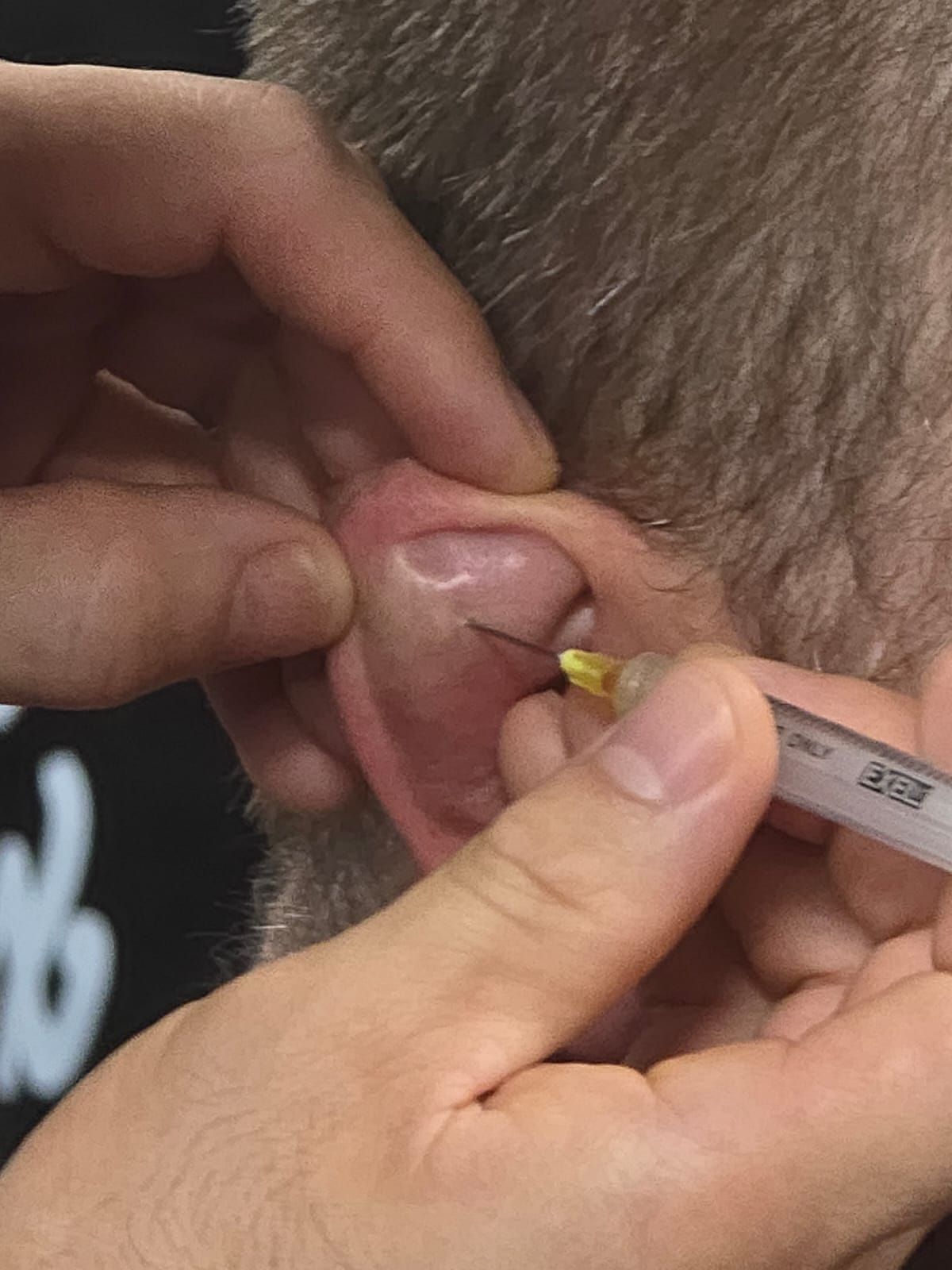
It started like so many other injuries in this sport do, with something that didn’t seem like a big deal. A little pain, a little swelling. Maybe just the aftereffects of a hard roll. But this time was different. I didn’t pay it much attention and kept rolling until one day after an open mat someone pointed out my ear had swollen up.  

And that’s when I knew: this wasn’t just a bruise. It was something more.

The Diagnosis

When I finally went to get it checked out, I was met with a word I wasn’t expecting: hematoma.
A collection of blood pooling in the muscle tissue. A reminder that the body has its own limits, even when the mind is still chasing the next belt, the next stripe, the next roll.

The doctor’s advice? Get it drained. Compressed. Ice. Rest. No training. Elevation. All the usual stuff that sounds simple until you realize what it really means: time away from the thing that keeps you grounded.

Ear hematomas are common in grappling and often lead to cauliflower ear. Some grapplers wear it like a badge of honor and I get that. But I wasn’t ready for the look. Having this happen to me for the first time in over six years of training caught me completely off guard.

The Mental Toll

What caught me off guard wasn’t the physical pain. It was the mental stillness. The way the days felt slower without the rhythm of training. The way the feelings I had used training to quiet came rushing back in. Sadness. Insecurity. Loneliness.


BJJ isn’t just exercise for me. It’s therapy. It’s where I process life, release tension, find clarity.

And without it, the silence crept in.
The doubts.
The restlessness.
The subtle fear that I might lose progress or worse, lose part of myself.

Recovery As a New Kind of Roll

Overtime, I realized recovery is its own kind of training.
You need patience. You need body awareness. You have to let go of ego. You have to listen.
Every time I resisted rest, I prolonged the healing. Every time I honored it, I took a step toward returning.

So I started to treat recovery like a roll: stay calm, breathe, don’t force the position. Adapt to what’s in front of you.

What I’ve Learned

This hematoma taught me that resilience isn’t just about pushing through, it’s also about knowing when to pause.
It taught me that slowing down doesn’t mean stopping.
That healing is a part of training. To trust my body.
And that sometimes, the most important grappling match is the one happening within.

Still Grappling

I’m still healing. Still learning. Still grappling (with headgear until it’s 100%).
But I have a deeper respect for my body, my mind, and the balance between drive and rest.

Because the mat will always be there.

The Power of Patience: Embracing the Slow Grind in Jiu Jitsu


Jiu Jitsu is often described as a “slow grind “and it teaches us one of the most valuable life lessons: the power of patience. Progress in this martial art is rarely quick or easy. Unlike some sports where immediate results are common, Jiu Jitsu requires long-term dedication, focus, and the ability to keep going even when it feels like you’re not improving.

The journey of learning Jiu Jitsu is a marathon, not a sprint. It’s not about instant gratification; it’s about the consistent, steady effort that leads to growth. Whether you’re rolling with a seasoned upper belt or struggling through a tricky submission, you quickly learn that each step in Jiu Jitsu, no matter how small, is a victory.

Embracing the Slow Grind of Jiu Jitsu

When you first start Jiu Jitsu, it can be overwhelming. The techniques seem complicated, the positions confusing, and the tapping out inevitable and often. You might feel like you’re stuck in a cycle of repeating the same drills without seeing significant improvements. But over time, this repetition is where the magic happens. You begin to notice the subtle shifts in your body’s movements, the increase in your strength and endurance, and the sharpening of your mental focus.

One of the beautiful things about Jiu Jitsu is that it forces you to embrace the process. You can’t rush through learning. The guard sweeps, submissions, and escapes that once seemed impossible eventually become second nature. Not because you pushed harder, but because you allowed yourself the time to truly understand each detail. This kind of progress doesn’t happen overnight, but it’s a profound realization when you realize how far you’ve come after months of patient practice.

There’s one thing I find myself telling new student’s often: “Don’t quit”. I can see the frustration in their face, in their body language and I get it. I was there. Overwhelmed. Exhausted. Confused. Defeated. You feel like it will always be like this, but the truth is, it won’t. Not if you stick with it and be patient.

Why Patience is Key

Patience is the key to unlocking Jiu Jitsu’s full potential. It teaches you that nothing worth having comes instantly. Progress in Jiu Jitsu is measured in small increments. Today, you might master a single detail of a technique, and tomorrow, you may struggle with the same technique again. But through persistence, those incremental victories build up over time, and before you know it, you’re executing complex movements without thinking.

This is where Jiu Jitsu mirrors life. The challenges we face aren’t always going to be solved in a single day or with a quick fix. Whether it’s in your career, relationships, or personal goals, success comes from the ability to show up consistently, day after day, despite not seeing instant results.

The Mental Benefits of Patience in Jiu Jitsu

Jiu Jitsu’s slow grind has profound mental benefits that extend beyond the mat. The ability to embrace the process teaches mental resilience, focus, and self-discipline. It shows you that setbacks are a natural part of growth. When you tap or fail at a technique, it’s not a reflection of your worth, it’s an opportunity to learn, adapt, and try again.

This mindset helps with emotional regulation, especially during stressful situations. Just like in Jiu Jitsu, when life throws challenges your way, practicing patience allows you to approach each obstacle with a clear and steady mind. You begin to see failure not as an end, but as a part of the journey, something to learn from, not something to avoid.

Patience Beyond the Mat: Life Lessons Learned from Jiu Jitsu

One of the most powerful aspects of Jiu Jitsu is how it teaches us patience that applies to all areas of life. Whether you’re facing a tough situation at work, navigating personal struggles, or simply trying to improve your fitness, the lessons learned on the mat: consistency, resilience, and slow, steady effort, are incredibly valuable.

Jiu Jitsu has a way of humbling you. You quickly learn that there’s no shortcut to mastery, and the same is true in life. The more you focus on putting in the work and being patient with yourself, the more you’ll grow, not just as a martial artist, but as a person.

Tips for Embracing the Grind in Jiu Jitsu

  1. Set Small Goals: Focus on mastering one technique or position at a time. Celebrate small victories, and don’t rush the process.
  2. Be Consistent: Show up regularly, even when you feel like you’re not progressing. The consistency will pay off in the long run. You don’t have to kill yourself by training everyday, but pick at least two or three days out of the week and be consistent.
  3. Reflect on Progress: Take time to look back at where you started and appreciate how far you’ve come. Tracking your journey can boost morale during tough times.
  4. Accept Setbacks: Understand that setbacks are normal. Don’t let temporary frustration derail your progress. Embrace each challenge as an opportunity to grow.
  5. Patience with Others: Be patient with your training partners as well. Everyone is on their own journey, and you’ll learn just as much by helping others as you will by focusing on your own growth.

Jiu Jitsu teaches us that patience is not just a passive waiting game, it’s an active part of the learning process. The slow grind is not something to fear but to embrace. The more we practice patience on the mat, the more we unlock the deeper lessons that Jiu Jitsu offers, lessons that go beyond technique and strength, and into the realm of mental and emotional resilience.

As you continue your Jiu Jitsu journey, remember that the slow grind is not a sign of stagnation but part of your growth. Every roll, every drill, and every tap out is a step forward, no matter how small it may seem in the moment. So, take a deep breath, enjoy the process, and trust that with each passing day, you’re getting closer to your goals.


From Addiction to Arm Bars: How Jiu Jitsu Aids in Substance Abuse Recovery

Over the years I have met a handful of Jiu Jisu practitioners who praised the benefits of Jiu Jitsu in aiding in their recovery efforts or curbing bad habits from everything from alcohol to cigarettes and even hard drugs. I for one, know that once I started training Jiu Jitsu regularly, I no longer had the time or desire for some of my old habits which included frequenting bars and drinking beer multiple nights per week. Those habits did not seem to be conducive to me performing well on the mats and the more I fell in love with training, the more I preferred to be on the mats sweating on any given night than in a bar drinking. That’s why it’s no surprise to me that Jiu Jitsu can definitely aid in helping kick a substance addiction.

Addiction is a chronic, relapsing disorder characterized by compulsive substance use despite harmful consequences. Substance use disorder can wreak havoc on an individual’s physical health, mental wellbeing, relationships, and overall quality of life. The road to recovery from addiction can be daunting and fraught with obstacles. However, the discipline of Brazilian Jiu Jitsu (BJJ), with its unique combination of physical, cognitive, and social components, can offer valuable support in this journey.

Understanding Addiction

To understand how Jiu Jitsu can help in addiction recovery, we first need to delve into the nature of addiction. Addiction is much more than a lack of willpower; it is a disease that affects both the brain and behavior. Long-term substance use can lead to changes in the brain’s structure and function, particularly in areas related to reward, stress, decision-making, and memory.

The Jiu Jitsu Way

Jiu Jitsu is not just a martial art; it’s a physical workout, a strategy game, a form of mindfulness, and a social activity, all rolled into one. Here’s how this multifaceted discipline can aid in the recovery process:

1. Reclaiming the Body

Substance abuse often leads to neglect of physical health. The regular physical exertion in Jiu Jitsu not only improves physical fitness but also cultivates a sense of respect for the body. It helps individuals understand their body’s capabilities and limitations, promoting a healthier relationship with their physical selves.

2. Natural Highs

Physical exercise, like that involved in Jiu Jitsu, stimulates the release of endorphins – neurotransmitters that produce feelings of pain relief and euphoria. This natural ‘high’ can serve as a healthy replacement for the artificial and harmful ‘high’ derived from substance use.

3. Mindfulness on the Mats

Jiu Jitsu requires complete mental engagement. Whether it’s a drilling session or a roll, practitioners need to stay present, focused on their movements and their opponents’. This is mindfulness in action, providing a temporary reprieve from cravings or ruminations about substance use.

4. Building Resilience

Recovery from addiction is a journey filled with setbacks and challenges. Resilience, the ability to bounce back from adversity, is therefore a vital skill in this journey. In Jiu Jitsu, every sparring session, every tap, is a lesson in resilience. Each time a practitioner gets back up after a defeat, they’re building their capacity to handle setbacks – a skill that’s invaluable in recovery.

5. A Sense of Achievement

Mastering a new technique, progressing in belt ranks, or just managing to stay on the mat for a minute longer than before – Jiu Jitsu is filled with measurable achievements. These successes can boost self-esteem and self-efficacy, countering the feelings of worthlessness and helplessness often associated with addiction.

6. The Power of Community

A strong support network is critical in the recovery process. The Jiu Jitsu community, with its ethos of respect and mutual aid, provides this much-needed support. The camaraderie on the mats can help combat the isolation that often accompanies addiction.

Jiu Jitsu: An Adjunct to Traditional Therapy

As a Jiu Jitsu practitioner and someone who has worked as an addiction’s counselor, I know that while the benefits of Jiu Jitsu in addiction recovery are compelling, it’s important to know that it’s not a standalone treatment. It should be seen as a complementary tool, used in conjunction with traditional treatment such as cognitive-behavioral therapy, Motivational Interviewing, medication, and support groups.

As you can see, the discipline of Jiu Jitsu offers more than just physical strength and self-defense skills. It provides a holistic approach to well-being that can support the journey from addiction to recovery. It’s a path that challenges and rewards in equal measure, fostering physical health, mental resilience, and social connection.

In the fight against addiction, every tool matters. And for many, Jiu Jitsu could be a powerful tool – a discipline that not only helps them combat addiction but also equips them with skills and principles that enrich their lives. As Helio Gracie, one of the founders of Brazilian Jiu Jitsu, said, “Jiu Jitsu is personal efficiency to protect the weaker, which anyone can do. It is the force of leverage against brute force.” Perhaps, in the context of addiction recovery, it’s the leverage of discipline, resilience, and community against the brute force of addiction.

Mind, Body, and Gi: The Psychological Benefits of Jiu Jitsu Training


There’s an old saying in martial arts circles: “Black belts are merely white belts who refused to quit.” Beyond the physical prowess and tactical skill that Brazilian Jiu Jitsu (BJJ) practitioners cultivate, it’s the mental fortitude, the grit, that makes this adage ring true. But the psychological impact of Jiu Jitsu extends far beyond perseverance. Through its physical maneuvers, strategic gameplay, and immersive nature, BJJ provides practitioners with a wealth of mental health benefits.

The Power of Now: Mindfulness in Action

Mindfulness, the practice of focusing on the present moment, is a cornerstone of mental well-being. It is often recommended as a tool to alleviate a host of mental health concerns, including stress, anxiety, and depression. The practice of Jiu Jitsu, while physically intense and demanding, is fundamentally an exercise in mindfulness. Whether you’re drilling a technique or engaging in a sparring session, your mind must be entirely present on the mats. You’re focused on your breathing, your movements, and your opponent’s actions. This focused attention on the here and now leaves no room for ruminations about the past or anxieties about the future.

Self-Efficacy and Mastery

Self-efficacy, the belief in our ability to succeed in specific situations, is a crucial aspect of mental health. It influences our motivation, decision-making processes, and emotional responses. In BJJ, as you progress in your training, master new techniques, and see your skills improve, your sense of self-efficacy naturally increases. The consistent challenge followed by the eventual mastery of techniques in Jiu Jitsu helps develop a mindset of growth and adaptability. This mindset, once ingrained, often seeps into other areas of life, improving our overall sense of well-being and competence.

The Emotional Release

Jiu Jitsu is more than just an excellent physical workout; it’s also a potent form of emotional release. Like other physical activities, it stimulates the release of endorphins, neurotransmitters that act as natural mood elevators. But it’s more than just the ‘runner’s high’ at play here. The physical intensity, the act of grappling and exerting your strength, provides a tangible outlet for pent-up emotions. The mats can become a safe space where you can channel your frustration, anxiety, or stress in a constructive, cathartic manner.

Building Resilience

Resilience, our ability to bounce back from adversity, is an essential psychological strength. In the world of Jiu Jitsu, resilience is not just encouraged; it’s required. Every time you tap, every time a technique doesn’t work, you face a mini-adversity. And each time you dust off and try again, you are building your resilience. Over time, this capacity to ‘roll with the punches’ can extend beyond the mat, helping you deal more effectively with life’s challenges.

A Tribe of Your Own: The Power of Community

We are innately social beings, and having a sense of belonging is crucial for our mental health. A Jiu Jitsu dojo is not just a place to train; it’s a community. It’s a place where respect, discipline, and support are core tenets. This environment fosters positive relationships and provides a social network that can act as a buffer against stress and other psychological issues.

Empowerment and Confidence

Empowerment is a powerful antidote to feelings of helplessness that often accompany mental health problems. As you progress in your Jiu Jitsu journey, as you become more proficient and confident in your skills, you experience a tangible sense of empowerment. This confidence can extend to other areas of life, improving your overall self-esteem and sense of worth.

Caution: Jiu Jitsu is Not a Cure

While the mental health benefits of Jiu Jitsu are manifold, it’s important to remember that it is not a replacement for professional psychological help. It is a tool, an adjunct to traditional therapeutic methods. It can enhance the effects of therapy, medication, or other treatments, but it should not be seen as a stand-alone solution for mental health concerns.

So why Jiu Jitsu? Why not just a regular gym workout or meditation? Because Jiu Jitsu is a comprehensive package. It’s a physical workout, a mindfulness practice, a form of therapy, and a social gathering rolled into one. It’s a discipline that demands respect for the body and nurtures the mind in the process.

Jiu Jitsu is a journey, one where the destination is not a belt color but a better understanding of yourself. It’s a path that, if walked with an open mind, can provide mental fortitude, emotional balance, and psychological well-being.

To paraphrase the words of Master Carlos Gracie Jr., “Jiu Jitsu is for anyone who seeks a path of self-knowledge, self-improvement, and self-confidence.” In the intricate dance of grips, rolls, and submissions, there’s a healing rhythm, a road to mental peace. So step on the mat, put on your gi (or not if you prefer no gi 🙂 ), and start this beautiful journey. One roll at a time.

The Art of Resilience: How Jiu Jitsu Helps Overcome Depression

When grappling with the grips of depression, it’s easy to feel lost, like you’re stuck in a position from which escape seems impossible. This feeling of hopelessness and helplessness is a tough opponent, one that requires resilience and strength of spirit to overcome. It’s here, on the canvas of our struggle, that Brazilian Jiu Jitsu (BJJ) can help us paint a picture of resilience and self-discovery.

The Jiu Jitsu – Depression Connection

I know many people who started Jiu Jitsu in the midst of battling with depression. Some were just getting out of a relationship and others were military veterans. The one thing they all had in common was that they were looking for something to be a part of and didn’t yet know the awesome benefits of training Jiu Jitsu when it comes to depression.

Jiu Jitsu, with its intricate network of techniques, patterns, and drills, provides a challenging but rewarding physical activity that stimulates both the body and mind. It requires the practitioner to be fully present, engrossed in the moment, much like meditation. For those battling depression, it offers an outlet, a space where they can focus their energies and momentarily step out of their gloom.

Building Resilience, One Roll at a Time

Depression often robs us of our self-esteem, but the Jiu Jitsu can help rebuild it, piece by piece. Every roll, every tap, every moment of breakthrough after a hard-earned struggle provides a sense of achievement. This achievement, regardless of how small, fuels the practitioner’s resilience – an essential trait when combating depression.

The Healing Power of Community

Jiu Jitsu doesn’t only promote physical engagement; it cultivates social interaction as well. The community that evolves in a Jiu Jitsu gym is one of support, respect, and camaraderie. This sense of belonging and acceptance can be a powerful antidote to the isolation and loneliness often felt in depression.

Physical Exercise and Mental Health

There’s an extensive body of research linking physical exercise to improved mental health. When we engage in physical activity, our body releases endorphins, known as ‘feel-good’ hormones, which can elevate our mood. Jiu Jitsu, with its demanding physical drills, can be a potent, natural antidepressant.

Learning to Embrace the Struggle

Jiu Jitsu teaches us to respect the struggle, to see it not as a blockade but as a catalyst for growth. It’s about finding comfort in the uncomfortable. And isn’t that what battling depression is all about? Embracing the struggle, finding ways to navigate through it, and coming out stronger on the other side. Jiu Jitsu will teach you that you’re tougher than you think you are and that it’s okay to not be perfect.

A Tool, Not a Cure

While the benefits are tangible, it’s important to remember that Jiu Jitsu isn’t a substitute for professional mental health treatment. It’s a tool, a supplementary practice that can fortify our mental health alongside therapy, medication, and other necessary interventions.

The journey of Jiu Jitsu, much like the journey through depression, is not a straight line. It’s a winding path, with hills and valleys. But by practicing Jiu Jitsu, we don’t merely learn how to grapple with our opponents; we learn how to grapple with our fears, our struggles, our inner demons. We learn that no position is impossible to escape from, and in the end, we emerge more resilient, more confident, and more in tune with ourselves.

In the words of Carlos Gracie Jr., “Jiu Jitsu is for the protection of the individual, the older man, the weak, the child, the lady, and the young woman – anyone who doesn’t have the physical attributes to defend themselves.” And perhaps, just perhaps, it can help protect us from the clutches of depression as well.

Don’t Be Afraid To Be A Beginner

Many people allow the fear of looking awkward or silly prevent them from trying something new. It could be anything from karaoke to going to their first yoga class. Just the thought of failing or looking clueless or awkward can be enough to prevent us from ever trying things we have dreamt of doing.

Remember when you first learned to walk or ride a bike? You probably don’t because it’s quite natural to you now, but if you see any old videos of yourself, you will see how unbalanced you were and how many times you fell, but never gave up. That’s what it is like trying something new. We can’t let the fear of looking stupid, like we don’t know what we are doing or even failing, rob us of the joy mastering (or at least being competent) in that area will bring.

That’s why I always get excited when I see new potential students come into our academy. Many of them are curious, they’ve always wanted to try Jiu Jitsu or some form of Martial Art but are apprehensive. Just walking through those doors for the first time can be extremely intimidating.

I remember when I first started training Jiu Jitsu and one of the hardest things I did was to walk through that door and start my first class. I had so much anxiety about it and most of my anxieties revolved around how silly I would look attempting to perform exercises and maneuvers I had never performed in my life.

I was worried about my conditioning because while I consider myself to be in somewhat decent shape, I knew I was not in the type of shape I thought I needed to be in for Jiu Jitsu. At that time, I was going to the gym and lifting weights nearly everyday, but I rarely did aerobic activity. I also knew that I could find a thousand excuses to keep putting off starting the class if I didn’t push myself to go despite those anxieties.

During my first few classes, I was really self-conscious and compared myself to everyone else. Most of the other guys were in better shape, quicker and more coordinated. I did feel like an awkward gorilla when we did many of the warmup exercises that required flexibility I didn’t have and left me sucking in air before the class even really begun. All of that started pushing doubt and excuses in my mind. “You’re too out of shape”, my inner critic said, “You’re too old, too tired, too busy” it added.

I live in my head like a lot of people, which isn’t always a good thing if you can’t master it. I had to quickly get out of my head. I did this by reminding myself that I was a beginner, and it was okay to look and feel like a beginner.

I had to tell myself that it was okay if I looked and felt awkward during the exercises, if I couldn’t perform some moves right, if at all. I told myself that it was okay if I got gassed during class and had to take a break. I was a beginner, and if there is ever a time to look awkward while trying your best, it’s when you’re a beginner.

Instead of being worried about being a beginner take advantage of it, embrace it.

When I started focusing more on myself and not on the other people in class things became easier. I had taken the pressure off of myself to be better than I reasonably could be. I pushed myself of course but took breaks when I needed to and learned to be unapologetic about it (by the way, no one ever made me feel bad about having to take a breather). I modified moves I couldn’t do until I could do them instead of getting upset, hurting myself or giving up out of frustration.

I worked on not caring about other people’s opinions.

So what if other guys in the class made fun of me or snickered about how this middle aged, muscular but uncoordinated guy flopped around on the mats like a fish out of water. They weren’t paying for my classes, I was. They weren’t in my shoes. We all have different lives and different goals. While some guys were there to compete for medals, I was there to get in shape and learn a martial art I had been curious about for over a decade. While some guys live to train, I have a full-time, stressful job and two young kids to divide my time with. Our goals and drives are completely different, and that’s okay.

Once I got out of my own head, allowed myself to be a beginner and stopped being concerned about what other people may think about me, things became fun! It helps that most people who train Jiu Jitsu seem to be non-judgmental and encouraging. You’ll hear them say, “We all started at the same point, don’t give up, just keep showing up”. And that’s exactly what I try to pass on to and motivate all new students when I see them struggling through warm-ups or getting frustrated that someone smaller than them is controlling them in ways they don’t yet understand.

I don’t think anyone ever looked at me and thought about how awkward I looked or how much my conditioning sucked. It was all in my head. Once I got out of my head and really focused on being mindful and present in the moment, I quickly realized I very rarely even thought about my dad bod, my clumsiness or my fitness level that much. As a matter of fact, Jiu Jitsu class became one of the few places I didn’t think too much about those things or other life problems at all. It became a stress reliever! That’s part of the reason I wanted to start this blog because Jiu Jitsu has helped me and so many others in ways that I would have never imagine if I didn’t embrace being new.

As far as Jiu-Jitsu is concerned, I am still a beginner and I allow myself to be a beginner, unapologetically.