The Art of Resilience: How Jiu Jitsu Helps Overcome Depression

When grappling with the grips of depression, it’s easy to feel lost, like you’re stuck in a position from which escape seems impossible. This feeling of hopelessness and helplessness is a tough opponent, one that requires resilience and strength of spirit to overcome. It’s here, on the canvas of our struggle, that Brazilian Jiu Jitsu (BJJ) can help us paint a picture of resilience and self-discovery.

The Jiu Jitsu – Depression Connection

I know many people who started Jiu Jitsu in the midst of battling with depression. Some were just getting out of a relationship and others were military veterans. The one thing they all had in common was that they were looking for something to be a part of and didn’t yet know the awesome benefits of training Jiu Jitsu when it comes to depression.

Jiu Jitsu, with its intricate network of techniques, patterns, and drills, provides a challenging but rewarding physical activity that stimulates both the body and mind. It requires the practitioner to be fully present, engrossed in the moment, much like meditation. For those battling depression, it offers an outlet, a space where they can focus their energies and momentarily step out of their gloom.

Building Resilience, One Roll at a Time

Depression often robs us of our self-esteem, but the Jiu Jitsu can help rebuild it, piece by piece. Every roll, every tap, every moment of breakthrough after a hard-earned struggle provides a sense of achievement. This achievement, regardless of how small, fuels the practitioner’s resilience – an essential trait when combating depression.

The Healing Power of Community

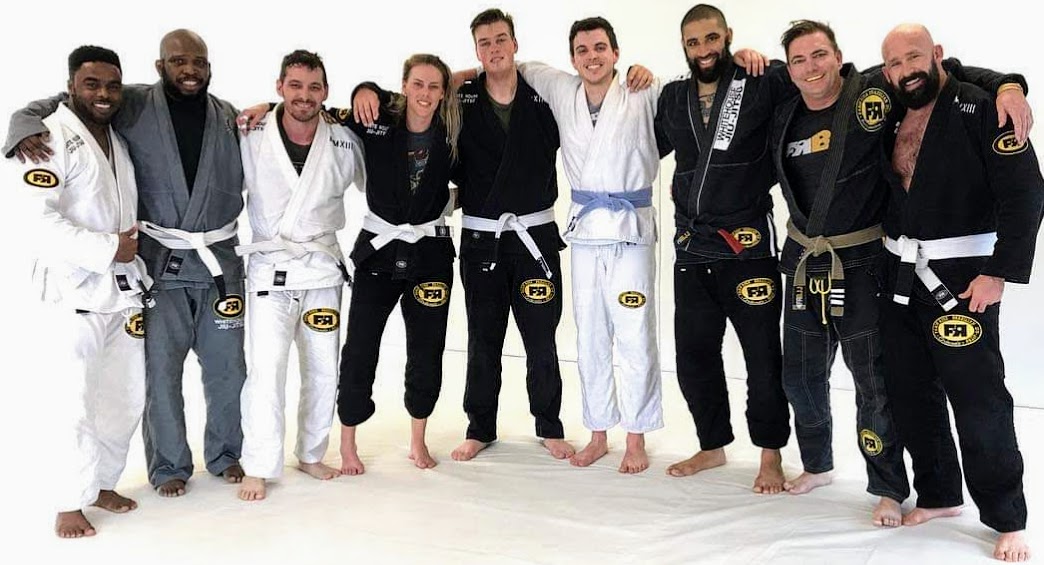
Jiu Jitsu doesn’t only promote physical engagement; it cultivates social interaction as well. The community that evolves in a Jiu Jitsu gym is one of support, respect, and camaraderie. This sense of belonging and acceptance can be a powerful antidote to the isolation and loneliness often felt in depression.

Physical Exercise and Mental Health

There’s an extensive body of research linking physical exercise to improved mental health. When we engage in physical activity, our body releases endorphins, known as ‘feel-good’ hormones, which can elevate our mood. Jiu Jitsu, with its demanding physical drills, can be a potent, natural antidepressant.

Learning to Embrace the Struggle

Jiu Jitsu teaches us to respect the struggle, to see it not as a blockade but as a catalyst for growth. It’s about finding comfort in the uncomfortable. And isn’t that what battling depression is all about? Embracing the struggle, finding ways to navigate through it, and coming out stronger on the other side. Jiu Jitsu will teach you that you’re tougher than you think you are and that it’s okay to not be perfect.

A Tool, Not a Cure

While the benefits are tangible, it’s important to remember that Jiu Jitsu isn’t a substitute for professional mental health treatment. It’s a tool, a supplementary practice that can fortify our mental health alongside therapy, medication, and other necessary interventions.

The journey of Jiu Jitsu, much like the journey through depression, is not a straight line. It’s a winding path, with hills and valleys. But by practicing Jiu Jitsu, we don’t merely learn how to grapple with our opponents; we learn how to grapple with our fears, our struggles, our inner demons. We learn that no position is impossible to escape from, and in the end, we emerge more resilient, more confident, and more in tune with ourselves.

In the words of Carlos Gracie Jr., “Jiu Jitsu is for the protection of the individual, the older man, the weak, the child, the lady, and the young woman – anyone who doesn’t have the physical attributes to defend themselves.” And perhaps, just perhaps, it can help protect us from the clutches of depression as well.
Jiu-Jitsu Naturally Improves Your Wellbeing

You’ve probably heard the saying “Jiu-Jitsu saved my life” and while that sometimes is an exaggeration, I have certainly met many practitioners where that may have literally true.

Some practitioners I know have quit using hard drugs once they fell in love with Jiu-Jitsu or cut back on drinking. Many others will tell you how Jiu-Jitsu has helped their anxiety, depression, confidence or helped get them through a tough time in their life like a divorce or other life stressors.

I myself say all the time that Jiu-Jitsu is my therapy. It’s the one place I come to relieve tension and not think about the millions of other things that weigh me down throughout the day.

For a long time, I wasn’t sure what it was about Jiu-Jitsu that made those who trained regularly fall in love with it. It thought perhaps it was just the release of dopamine or the relationships we build with our teammates, but the other day when I took a seminar on positive psychology, I realized that Jiu-Jitsu gives us much more than that.

Jiu Jitsu Increases Our Sense of Well-Being

The pursuit of happiness is something that most of us have in common and try to achieve in one way or another. Happiness however is often hard to define. In 2012, Dr. Martin Seligman (one of the fathers of positive psychology) described five components that people pursue because they are intrinsically motivating and contribute to wellbeing:

  • Positive emotion
  • Engagement
  • Relationships
  • Meaning
  • Accomplishments

He coined those five components “PERMA” and in my opinon that is exactly what Jiu-Jitsu gives us.

Positive Emotions

In Jiu-Jitsu we are always provided with the opportunity for positive emotions (hope, interest, joy, love, compassion, pride, amusement, and gratitude). Experiencing positive emotions helps negate many of the negative emotions we deal with and help make us more resilient against negative emotions.

I can’t think of a class I have taken or Jiu-Jitsu related even I have been too where at some point I am not smiling, laughing or feeling good vibes.

Engagement

Engagement as referred to by Dr. Seligman is “being one with the music” or being “in flow”. Flow refers to the loss of self-consciousness and being completely absorbed in an activity. You’re in the present and totally focused on the moment.

Anyone who trains can tell you that especially when rolling (live sparring) you often enter a state of flow without realizing it. It’s hard to think about that report that is due tomorrow when your teammate is trying to strangle you or when you finally see an opportunity to hit an escape you’ve been trying to hit all week.

There are many times I almost didn’t go to class because I wasn’t feeling well mentally or physically and all that goes away as soon as I start rolling and suddenly, at least in that moment, I feel really good.

Flow, or this concept of engagement, occurs when the perfect combination of challenge and skill/strength is found (Csikszentmihalyi & LeFevre, 1989).

Rickson Gracie even wrote a book entitled Breath: A Life in Flow which I have read and gifted to several people.

There are many other ways we can practice entering a state of flow by being present such as spending time in nature or engaging in things we really enjoy and can get lost in, but Jiu Jitsu does that naturally and beautifully without us even thinking about it.

Relationships

Positive relationships are very important in having a sense of well-being. Positive relationships include relationships where we feel loved, supported and valued. Jiu Jitsu again does this naturally. If you find the right academy for you, it’s only natural that those strangers will quickly become like family. As hard as they may push you in training, they are always happy to see you, encouraging, want to see you improve and care about you.

I was telling one of my Jiu-Jitsu teammates who I now consider a very close friend that the last time I genuinely made good male friends was my sophomore year in high school. Now at my academy I have training partners I consider brothers and sisters, people I can talk to about my problems and also help them with theirs or just be a sounding board. I have people I laugh with and enjoy spending time with on and sometimes off the mats.

For the most part, the entire Jiu Jitsu community tends to be like that, but of course you will develop special relationships at your academy and probably make more friends than you have made in a long time.

One’s social environment has been found to play a critical role in preventing cognitive decline, and strong social networks contribute to better physical health among older adults (Siedlecki et al., 2014).

Meaning

Having a sense of meaning or purpose in life is extremely important and it’s different for everyone, however training gives us a sense of meaning and purpose in many ways.

Some people train because they want to achieve a black belt someday. Others train for self-defense or physical fitness. Others train because they like to help teach the new student, lower belts or kids classes when they can. They enjoy giving back and helping others. Some train because they enjoy challenging themselves or competing. Others train because they enjoy being a part of something bigger than themselves.

For me it started as a journey of physical fitness and something I wanted to be able to teach my son and it still is, but now I want to achieve a black belt someday. I also enjoy teaching new students and being a part of a family of men and women from different worlds and cultures, but we all share the same passion.

People who report having purpose in life live longer, have greater life satisfaction and fewer health problems (Kashdan et al., 2009).

Accomplishments

Accomplishment in PERMA is also known as achievement, mastery, or competence and that’s another thing that training Jiu-Jitsu offers. It can be small accomplishments like making it through the warmups without resting (that was my goal for the first few weeks when I first started), to perfecting a sweep, guard or move. It can be but doesn’t nor should it always be about stripes and belt promotions because we all know that while those definitely feel great and are encouraging, they often are out of our control.

We achieve a sense of accomplishment by working toward and reaching goals, mastering something and/or having the self-motivation to finish something we set out to do. This contributes to wellbeing because individuals can look at their lives with a sense of pride (Seligman, 2012).

So now when I look back on how and why Jiu-Jitsu is so life changing for myself and others who fall in love with it, I see that it’s because Jiu-Jitsu offers all of us opportunities to work on our well-being and happiness by providing us PERMA regularly.

Research has shown positive associations between each of the PERMA components and physical health, vitality, life satisfaction and commitment. Proactively working on the components of PERMA have also been shown to decrease psychological distress and increase wellbeing.

Of course, there are other ways and other opportunities to work on and increase PERMA in your life and Jiu-Jitsu shouldn’t be your sole source for all of it, but it’s beautiful that it offers so much instinctively.

Don’t Be Afraid To Be A Beginner

Many people allow the fear of looking awkward or silly prevent them from trying something new. It could be anything from karaoke to going to their first yoga class. Just the thought of failing or looking clueless or awkward can be enough to prevent us from ever trying things we have dreamt of doing.

Remember when you first learned to walk or ride a bike? You probably don’t because it’s quite natural to you now, but if you see any old videos of yourself, you will see how unbalanced you were and how many times you fell, but never gave up. That’s what it is like trying something new. We can’t let the fear of looking stupid, like we don’t know what we are doing or even failing, rob us of the joy mastering (or at least being competent) in that area will bring.

That’s why I always get excited when I see new potential students come into our academy. Many of them are curious, they’ve always wanted to try Jiu Jitsu or some form of Martial Art but are apprehensive. Just walking through those doors for the first time can be extremely intimidating.

I remember when I first started training Jiu Jitsu and one of the hardest things I did was to walk through that door and start my first class. I had so much anxiety about it and most of my anxieties revolved around how silly I would look attempting to perform exercises and maneuvers I had never performed in my life.

I was worried about my conditioning because while I consider myself to be in somewhat decent shape, I knew I was not in the type of shape I thought I needed to be in for Jiu Jitsu. At that time, I was going to the gym and lifting weights nearly everyday, but I rarely did aerobic activity. I also knew that I could find a thousand excuses to keep putting off starting the class if I didn’t push myself to go despite those anxieties.

During my first few classes, I was really self-conscious and compared myself to everyone else. Most of the other guys were in better shape, quicker and more coordinated. I did feel like an awkward gorilla when we did many of the warmup exercises that required flexibility I didn’t have and left me sucking in air before the class even really begun. All of that started pushing doubt and excuses in my mind. “You’re too out of shape”, my inner critic said, “You’re too old, too tired, too busy” it added.

I live in my head like a lot of people, which isn’t always a good thing if you can’t master it. I had to quickly get out of my head. I did this by reminding myself that I was a beginner, and it was okay to look and feel like a beginner.

I had to tell myself that it was okay if I looked and felt awkward during the exercises, if I couldn’t perform some moves right, if at all. I told myself that it was okay if I got gassed during class and had to take a break. I was a beginner, and if there is ever a time to look awkward while trying your best, it’s when you’re a beginner.

Instead of being worried about being a beginner take advantage of it, embrace it.

When I started focusing more on myself and not on the other people in class things became easier. I had taken the pressure off of myself to be better than I reasonably could be. I pushed myself of course but took breaks when I needed to and learned to be unapologetic about it (by the way, no one ever made me feel bad about having to take a breather). I modified moves I couldn’t do until I could do them instead of getting upset, hurting myself or giving up out of frustration.

I worked on not caring about other people’s opinions.

So what if other guys in the class made fun of me or snickered about how this middle aged, muscular but uncoordinated guy flopped around on the mats like a fish out of water. They weren’t paying for my classes, I was. They weren’t in my shoes. We all have different lives and different goals. While some guys were there to compete for medals, I was there to get in shape and learn a martial art I had been curious about for over a decade. While some guys live to train, I have a full-time, stressful job and two young kids to divide my time with. Our goals and drives are completely different, and that’s okay.

Once I got out of my own head, allowed myself to be a beginner and stopped being concerned about what other people may think about me, things became fun! It helps that most people who train Jiu Jitsu seem to be non-judgmental and encouraging. You’ll hear them say, “We all started at the same point, don’t give up, just keep showing up”. And that’s exactly what I try to pass on to and motivate all new students when I see them struggling through warm-ups or getting frustrated that someone smaller than them is controlling them in ways they don’t yet understand.

I don’t think anyone ever looked at me and thought about how awkward I looked or how much my conditioning sucked. It was all in my head. Once I got out of my head and really focused on being mindful and present in the moment, I quickly realized I very rarely even thought about my dad bod, my clumsiness or my fitness level that much. As a matter of fact, Jiu Jitsu class became one of the few places I didn’t think too much about those things or other life problems at all. It became a stress reliever! That’s part of the reason I wanted to start this blog because Jiu Jitsu has helped me and so many others in ways that I would have never imagine if I didn’t embrace being new.

As far as Jiu-Jitsu is concerned, I am still a beginner and I allow myself to be a beginner, unapologetically.