
Somewhere along the way, most adults stop playing.
As kids, play is everywhere. We run, climb, wrestle, invent games, and laugh when things get chaotic. The world feels like something to explore. There is curiosity, movement, and experimentation.
But adulthood slowly replaces play with responsibility.
Work. Bills. Deadlines. Schedules. Stress.
Before we know it, most of our days become structured around productivity. We start measuring time by how useful it is. Anything that doesn’t have a clear purpose can start to feel like a waste.
And then something interesting happens when you step onto a Jiu-Jitsu mat. Once you get over the initial anxiety, let the ego go and allow yourself to relax, something almost magical happens.
Without realizing it, you start playing again.
The Quiet Disappearance of Play
Many adults don’t notice when play disappears from their lives.
It happens gradually.
The pick-up games stop. The spontaneous wrestling with friends fades. The idea of doing something purely for the joy of it becomes less common.
Somewhere along the way we start believing that play is something children do, while adults are supposed to be serious, efficient, and productive.
But our minds and bodies never stopped needing play.
In fact, psychologists have long understood that play is essential for emotional regulation, creativity, and resilience. It allows the brain to experiment, reset, and recover from stress. Don’t even get me started on the need for touch and physical connection that humans need and yet it tends to become less and less common as we get older.
Play isn’t childish.
It’s human.
Jiu-Jitsu Is Structured Play
At first glance, Brazilian Jiu-Jitsu might look like the opposite of play.
Two adults trying to control each other on the ground. Chokes. Joint locks. Sweat. Physical pressure.
But anyone who trains knows something different is happening beneath the surface.
Rolling is essentially a game.
Every round is a puzzle.
You try something. Your partner counters. You adjust. They adapt.
The entire experience becomes a moving conversation between two bodies solving problems in real time.
Sometimes you’re experimenting with a new guard.
Sometimes you’re seeing if an escape works against resistance.
Sometimes you’re just trying something ridiculous to see what happens.
That’s play.
Why the Jiu-Jitsu Feel So Good for the Mind
One of the reasons people fall in love with Jiu-Jitsu is because of what happens mentally during a roll.
For a few minutes, your mind has no choice but to be present.
You aren’t thinking about work.
You aren’t worrying about bills or emails or tomorrow’s responsibilities.
Your entire focus narrows to what’s happening in that moment.
Grip. Frame. Breathe. Move.
It becomes a kind of moving meditation.
From a psychological perspective, this kind of immersive activity creates what researchers call flow, a mental state where attention is fully absorbed in the task at hand. Flow is strongly associated with improved mood, reduced stress, and a deeper sense of satisfaction.
In other words, rolling doesn’t just train your body.
It resets your mind.
The Joy Hidden Inside the Struggle
If you look around a Jiu-Jitsu gym after a hard round, you’ll often see something interesting.
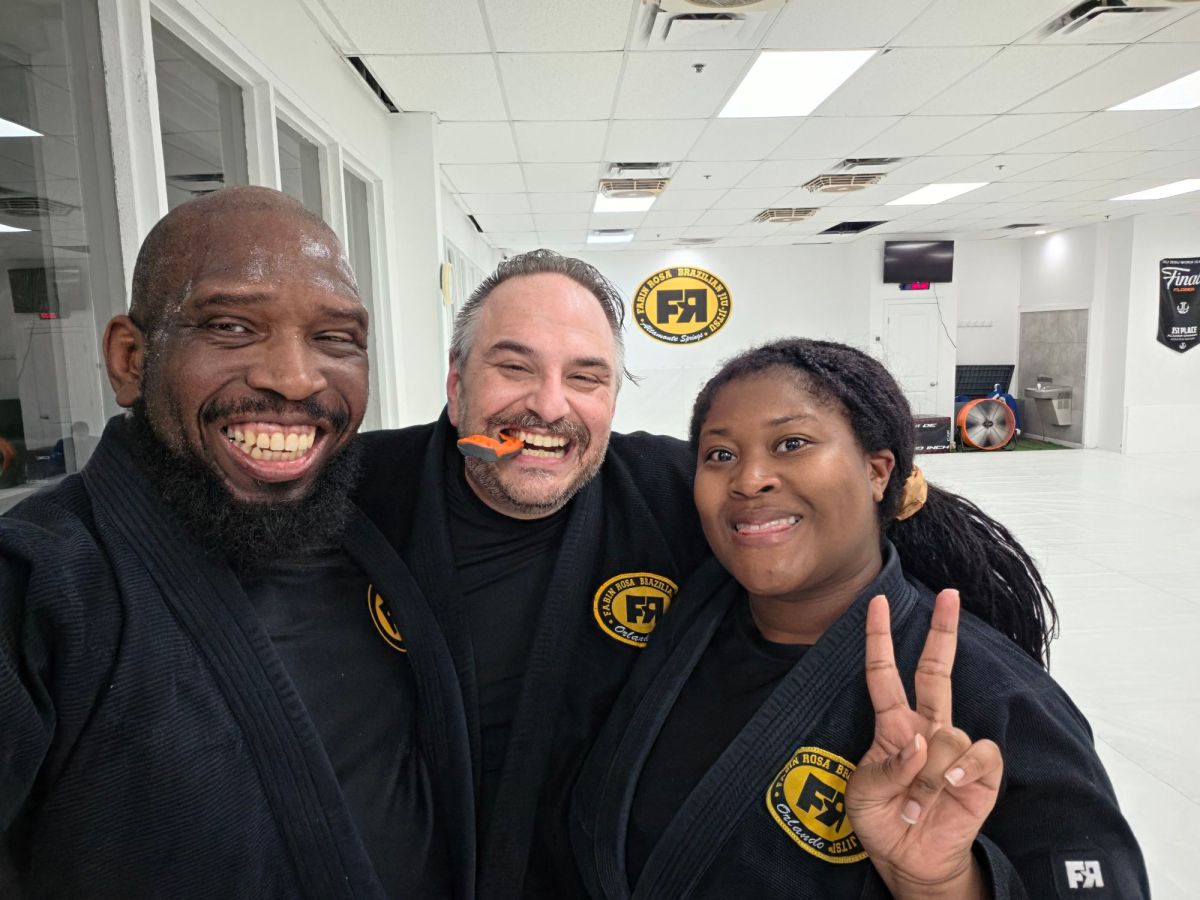
People are smiling.
Even after getting tapped.
Even after being smashed.
You might see two training partners laughing while trying to figure out what just happened in a scramble.
That’s another sign of play.
The struggle itself becomes enjoyable.
You’re learning, experimenting, failing, adjusting, and trying again. It taps into the same instinct we had as kids when we wrestled in the grass or tried to climb something a little too big for us.
The difference is now we’re doing it with a little more awareness.
The Real Gift of Jiu-Jitsu
People start Jiu-Jitsu for many reasons.
Self-defense.
Fitness.
Competition.
Stress relief.
But one of the gifts it quietly gives back is something many adults didn’t realize they lost.
Play.
One of my professors often says in his thick Brazilian accent, “Go play with yourselves”, meaning, go have fun, experiment with moves and don’t take it too serious.
For an hour or two, a few times a week, we get to step away from the seriousness of life and enter a space where curiosity, experimentation, and movement take over.
We get to try things.
We get to fail safely.
We get to learn.
And sometimes, without even noticing it, we get to feel a little bit like kids again.
Rolling around on the floor, solving puzzles, and laughing at the chaos.
Maybe that’s part of why we keep coming back.

 Grappling with Jiu-Jitsu